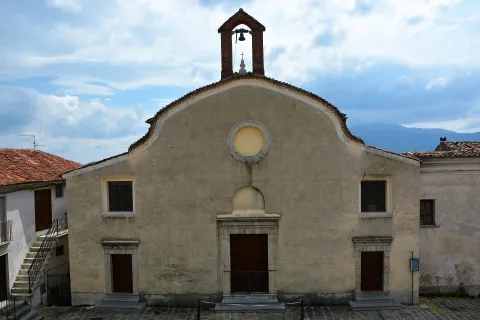
Ferdinando Petruccelli was not born with the surname Moliterno remembers him by: «della Gattina» was the name of a farm he owned, and he tacked it on himself to throw the Bourbon police off his trail. He was born in the town on 28 August 1815, the son of a doctor enrolled in the Carboneria, and died in Paris on 29 March 1890, after a life spent almost entirely writing against somebody.
What to see
The career begins with a medical degree from the University of Naples that he would never use: his first articles came out in 1838, then he left as a correspondent for France, Britain and Germany. In 1846 he was arrested for belonging to Giovine Italia and sent back to Moliterno itself, under police supervision. In 1848 he sat as a deputy in the Neapolitan constitutional parliament for the district of Melfi and ran «Mondo vecchio e mondo nuovo», a paper so venomous that his opponents dismissed it as a filthy little rag and the courts eventually shut it down, despite the run of new mastheads he kept inventing for it.
When the 1848 revolution failed, with a bounty on his head and a death sentence in absentia, he spent a year in hiding between Calabria, Basilicata and Cilento, then escaped to France. In Paris they called him Pierre Oiseau de la Petite Chatte, a rough translation of his name; he wrote for La Presse and for the Journal des débats, and in 1851 he fought alongside the republicans against Louis Napoleon's coup, which cost him expulsion from the country. In London he worked for Charles Dickens's Daily News. He returned to Italy in Garibaldi's wake, still as a correspondent, and in 1861 was elected deputy for the Brienza constituency. What the new Italy left him was mostly disappointment, set down in 1862 in «I moribondi del Palazzo Carignano», the sarcastic portrait of his fellow deputies in Turin that Indro Montanelli would call the pearl of Italian memoir writing of the period.
Visiting
The monument stands outdoors: no opening hours, no ticket. Moliterno sits at 879 metres above the Val d'Agri, and the town Petruccelli was sent back to in 1846 is still the one pressed around its medieval castle, grown out of the Lombard tower where the survivors of Grumentum had gathered.
Our editors' tip
Give an hour to the MAM, the Musei Aiello Moliterno: the section devoted to Michele Tedesco and the Lucanian nineteenth century covers exactly Petruccelli's own century, and it shows what kind of province produced a man who ended up earning his living in Paris writing in French.