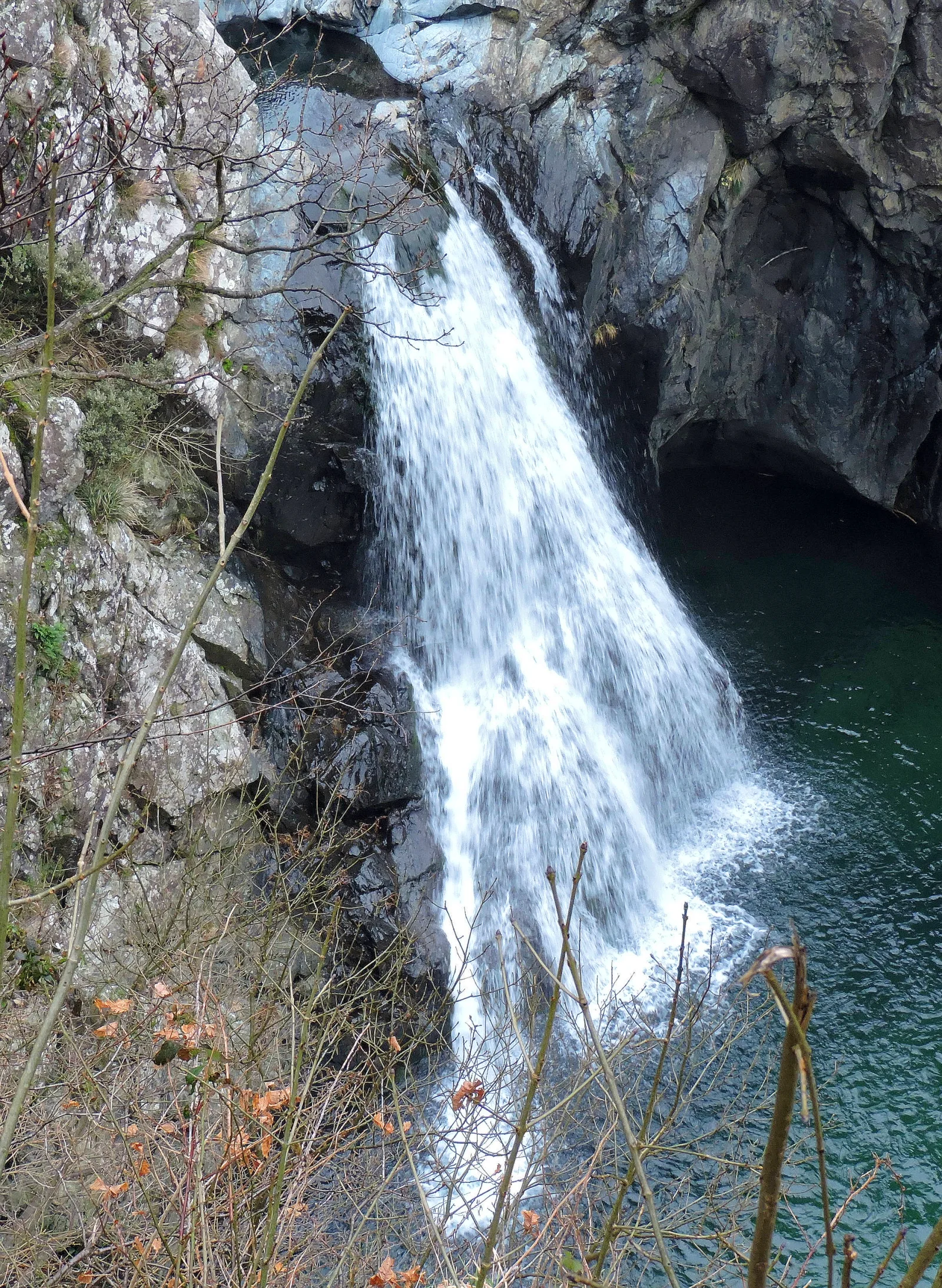
The waterfall was once called cascata delle Cheucie, and the name «del Serpente» belonged only to the small lake that gathers the water at its foot. Usage then swapped the two round: today the Serpente is the waterfall, while the Cheucie survive on old maps. It is formed by the rio Masone, a left-hand tributary of the Stura di Ovada, inside a narrow, deeply cut valley; together with four smaller drops it makes up the cascate del Serpente complex, just above the village.
What to see
The most interesting thing here is geological, and you can read it in the step the water throws itself from. A drop usually forms where two different rocks meet, a soft one that wears away and a hard one that holds. Here the rock is always the same, the greenschists that make up the sides of the little valley: what changes is only how fractured it is. Where the stone is less broken the water had a harder time cutting into it, that compact band stayed standing, and the stream now falls over it into the lake below. The Parco naturale regionale del Beigua lists the spot among its sites of geomorphological interest.
Not far from the falls the park laid out a botanical trail, put together with the secondary school in Masone. It is worth hunting down what remains of the water industry too: near the drop stand the ruins of the old cartiera Savoi, a paper mill driven by water power, and further down, close to where the stream joins the Stura, you can still make out the walls of a large mill.
Visiting
From the centre of Masone you get there by car, or on foot in about half an hour, with no difficulty. Anyone wanting to carry on will find the path climbing towards the watershed between Liguria and the Po plain and the Bric del Dente area. The main drop and the smaller ones are also the backbone of a canyoning route, partly equipped as a via ferrata: proper gear and the right company are essential, this is not a longer version of the walk. In summer the lake under the waterfall fills up with local bathers.
Our editors' tip
Go on a weekday and outside the height of August, when the pool is besieged: the waterfall reads far better with few people around, and the sound of the water becomes the only one again. We suggest giving half an hour more to the ruins of the paper mill, which almost nobody looks for, and walking up the path even for a quarter of an hour: from up there you understand how the stream cut the valley.