The foundation date is known to the day: 13 June 1208. That day Cistercian monks took possession of land in the hamlet of Porale, in the hills behind Ronco Scrivia, and built a monastery with a stated purpose that went beyond the cloister: to give rest and prayer to the pilgrims travelling the Via Postumia. The community held the site for more than two centuries, until the bull of 27 October 1481 with which Pope Sixtus IV suppressed it. From then on the story of the abbey is the story of a property changing hands: it passed to the Lateran Canons Regular of the priory of San Teodoro in Genoa and remained church property until 1750, when the whole complex was sold to the count of Ronco Scrivia, Napoleone Spinola.
What to see
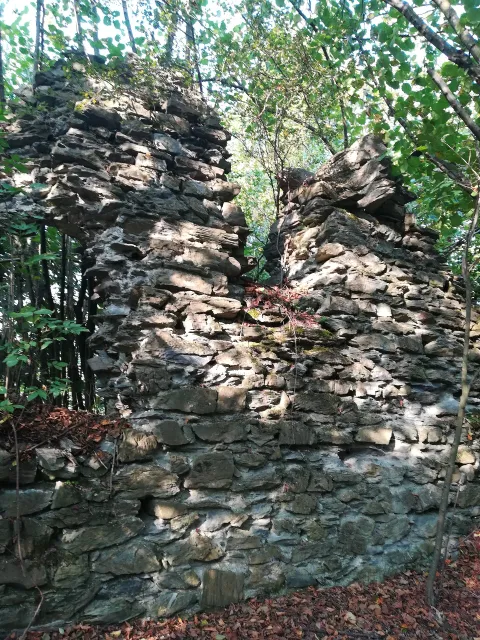
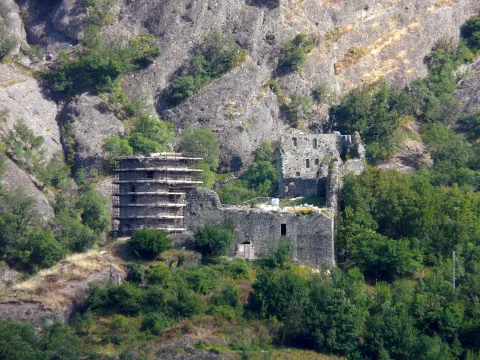
Anyone arriving expecting an abbey finds a chapel, and that is the first thing to accept. The medieval monastery no longer exists as a building: only a few traces of it survive, absorbed into the structure standing today, and the best way to look for them is to walk around the walls before going in.
The piece that justifies the detour is above the high altar: a fresco of 1446 showing the Madonna between Saint James and Saint Philip. Some studies hold that it was repainted during the eighteenth century, so it repays looking at with two hands in mind, the fifteenth-century composition and the later reworking. Saint James, patron of pilgrims, is not a random devotional detail: he is a reminder of what this house was for when it was built.
Visiting
Porale is reached by car from Ronco Scrivia, in the Scrivia valley behind Genoa; the town has a station on the railway line to the city. A hamlet chapel does not keep the hours of a town church: finding it locked outside services is normal, so anyone set on seeing the fresco should ask locally or at the parish first. There is no tourist circuit around it: you arrive, you look, you leave.
Our editors' tip
We suggest coming here with the road in mind rather than the word 'abbey'. Read as a staging post, as a place where eight hundred years ago a traveller could stop, sleep and set off again in the morning, this small building makes far more sense than it does measured by its size. We take a few minutes outside before going in, and we pair the visit with a drive through the Scrivia valley: on its own the chapel is a short stop, within the valley it becomes part of a story.