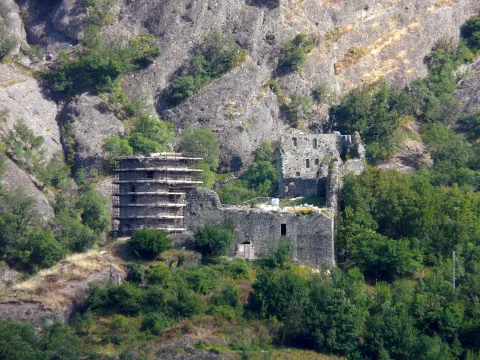
Of the old fortress only a few elements survive, and the most telling is a fragment of walling in squared cut stone: that is all time has left of the castle of Ronco Scrivia. It went up between the eleventh and twelfth centuries and soon passed to the Spinola family, who also used it as a refuge for exiled Genoese nobles. That role cost it dearly: in 1173 Genoese troops stormed and took it. In 1223, after the council between Genoa and Tortona-Alessandria, it was the Lombard League that ordered the Genoese to return the property to the Spinola, and in 1313 the family obtained official investiture from Emperor Henry VII of Luxembourg. From fortress the complex became the residence of the marquises, lived in until 1797, when the imperial fiefs fell for good with Napoleon Bonaparte.
What to see
It helps to arrive knowing what is not here: no intact towers, no crenellated wall, no rooms to walk through. The medieval castle has survived in pieces, and the most legible of them is that stretch of wall in squared blocks, the one place where the military fabric can still be told apart from what grew up around it.
The rest of the story is told by the building's conversion. When the Spinola stopped defending and started living, the castle became the marquises' residence and stayed that way for nearly five centuries, until the end of the eighteenth. It is the usual arc of the imperial fiefs in the Genoese hinterland: first defence counts, then the family name counts.
Visiting
Ronco Scrivia is easy to reach: the station is served by the historic Turin-Genoa line and by the Giovi bypass line, the state road 35 dei Giovi runs through the town, and the A7 motorway has an exit here. The remains are in the main settlement; the encyclopaedia entry gives no precise address, so on the ground it is worth asking. No opening hours, tickets or guided tours are listed.
Our editors' tip
Our advice is to treat it not as a visit but as a fact-check. Bring the dates with you, look for the wall in squared stone, and try to picture the assault of 1173 in a town that is now above all a knot of roads and railway lines. Give the rest of your time to the village and the Scrivia valley: here the context is worth more than the monument.