The five bells of the parish church of Borgo Fornari are the largest in the whole Scrivia valley: the biggest weighs about a tonne and a half on its own, and the peal, tuned to D flat major, was cast in 1886 by the Pasquale Mazzola foundry of Valduggia. The tower that carries them was rebuilt in 1752 beside the façade; before that it stood on the other side, next to the choir, as a survey map of 1645 shows, and it held two bells cast in 1374 by master Carlo Lanxarotto. The church stands a little apart from the village, as old country parishes often did: Santa Maria di Ceta — the name comes from the nearby mountain, today called Rivà — appears in a document of 1127 and is listed in a register of 1198. In 1248 Pope Innocent IV detached it from Tortona and assigned it to the archdiocese of Genoa.
What to see
The building we see today is the result of successive reconstructions. The war of 1625 between the Republic of Genoa and the Duchy of Savoy damaged it badly; in 1650 the old fabric was pulled down and the new church was completed in 1666. A fire set by Austrian troops forced another rebuilding in the eighteenth century, and by the early nineteenth the place was in ruins again. Its present look, a Piedmontese Baroque of unusual lightness, comes from the renewal ordered in 1913 by the archpriest don Giovanni Roggerone. The interior has three aisles, with stucco and gilding; in the presbytery the seventeenth-century marble altar still carries the Spinola coat of arms.
The frescoes are all by Rodolfo Gambini: Gethsemane and the appearance to the disciples at Emmaus on either side of the presbytery, and on the vault the Coronation of the Virgin, the Madonna of the Rosary, Saint Anne and Blessed Maria Vittoria Fornari Strata, a descendant of the feudal lords who gave the village its name. Two canvases repay a pause: the Flagellation by Giovanni Raffaele Badaracco and the Saint John the Baptist in the Desert by Giovanni Andrea De Ferrari, datable to the third decade of the seventeenth century. In the left-hand chapel the statue of the Assumption was carved in 1878 by the Genoese Paolo Olivari; the pipe organ on the inner façade has been in use since 1822.
Visiting
Borgo Fornari is a hamlet of Ronco Scrivia and the church stands on via Giuseppe Mazzini, just outside the built-up centre; it is a few minutes on foot from the railway station. This is a working parish in the Valle Scrivia vicariate, so the doors follow the times of services: the safest slot is Sunday morning, before or after Mass. The restoration of 1984 consolidated the load-bearing structures and cleaned the stucco and frescoed surfaces, so the interior reads well even when natural light is scarce.
Our editors' tip
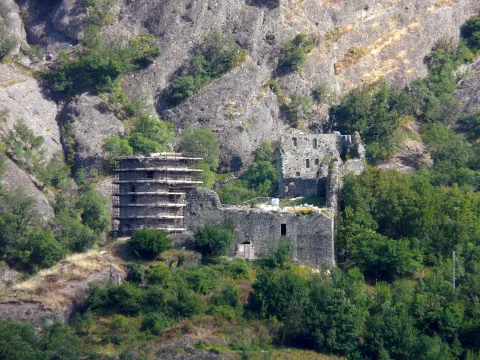
Take the time to look at the altars one by one: in 1889 there were seven of them, and nearly every one carries the name of whoever paid for it, the Borzone, the Carpaneto, Geo Davidson. It is the most direct way to understand who kept a valley parish standing. Then step outside and take the lane climbing towards the castle: ten minutes of walking, and you see why church and fortress watch the same road.