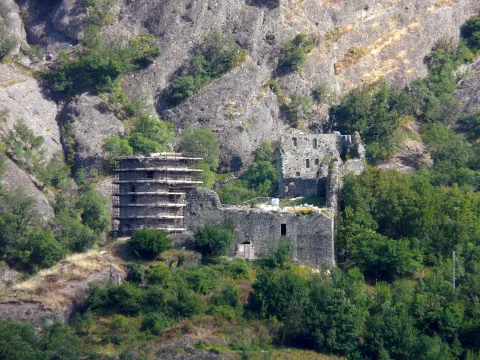
Five sovereigns stopped at this castle within half a century: Louis XII of France in 1506, then Charles V of Habsburg, Francis I of France in 1525, Philip II of Spain and Maximilian II of Habsburg in 1551. This was not aristocratic courtesy. The castle of Borgo Fornari stands on a height commanding the road between the Scrivia valley and Voltaggio, then a Genoese fief, and anyone who wanted to pass went under its walls. Its construction is placed between 1121 and 1182; some sources credit the Fornari, a Genoese family that left the village its name.
What to see
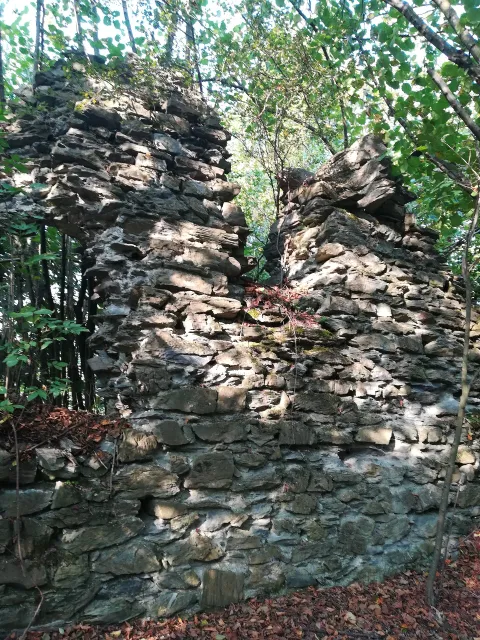
Part of the complex survives. Above all the semicircular tower in exposed brick, well preserved and held by scholars to be the oldest element; on the west side a stretch of wall remains, which historians describe as the only masonry of its kind still standing in the valley of the Scrivia. Towards the valley floor another section is intact, assigned by some hypotheses to the garrison.
Looking at the walls you notice the change of material: stone in the lower part, brick in the upper, the mark of different building campaigns following one another over time. The rest is told by the history of ownership, which passed from the Fornari to the Spinola, who stayed here, with the quarrels against the Doria that followed. In the fifteenth century the fortress again became a battleground between the Spinola and the Republic of Genoa: Filippo Maria Visconti, allied to the former, secured it and handed it over to Pope Martin V, as the peace agreements of May 1419 required.
Visiting
You climb on foot from the main street of Borgo Fornari, a hamlet of Ronco Scrivia, taking the lane locals call Rian-na: about ten minutes uphill, easy enough but on uneven ground and with no conspicuous signage. The castle belongs to the municipality — Ronco Scrivia bought it and in 2005 obtained funding for conservation work — and is seen mainly from outside: there is no ticket office and no museum route, so it is worth asking at the town hall before counting on getting in.
Our editors' tip
Go in the late afternoon, when the raking light separates the red of the tower's brick from the green of the slope. And before you head down, turn towards the valley floor: from up there the road to Voltaggio can be read end to end, which is why this heap of stones cost the Spinola, the Doria and the Visconti centuries of feuding.