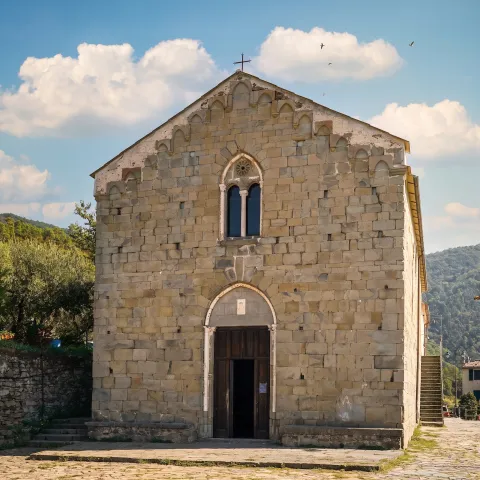
The fifteenth-century wooden crucifix hanging above the font was never commissioned by anyone: it was picked up on the beach of Vallesanta, west of Levanto, after a storm, and the devotion of the townspeople has never let go of it since. Sant'Andrea is the largest Romanesque building on the eastern Ligurian coast: thirteenth-century documents mention it several times, one of them dated 1222 marking the presumed start of the works, and by about 1230 it was far enough along to host, before a notary, the meeting between the Da Passano lords and the citizens of Levanto over the pacts that placed the town under the Republic of Genoa. It was consecrated on 20 May 1463, after the enlargement begun in 1450.
What to see
The façade is faced in alternating bands of white Carrara marble and green serpentinite, the Genoese Gothic motif par excellence; along the top run hanging arches ending in apotropaic heads, and a marble rose window opens at the centre. In the lunette above the Gothic doorway, a fifteenth-century fresco of the Piedmontese school shows the Virgin enthroned with the Child between Saint Andrew and Saint John the Evangelist. Façade, rose window and interior all passed, between the late nineteenth and the early twentieth century, through the hands of Alfredo d'Andrade, the architect of Liguria's great restorations, who took the building back to what he believed its medieval appearance to be.
Inside there are five naves: the fifteenth-century enlargement broke through the side walls and doubled the space, and the slender columns of the central nave repeat the two-tone banding of the façade. Look for the carved wooden choir of 1589 in the apse, the Serassi organ of 1825, the pulpit dated 1716 with the town's coat of arms in marble inlay, the relief slab of bishop Bartolomeo Pammoleo carved by Michele d'Aria, and the font in the red marble of Levanto, the local stone. The treasury also holds a silver chalice of Parisian make known as Henry VIII's, usually displayed in the diocesan museum in La Spezia and brought back to town only for special occasions.
Visiting
Sant'Andrea stands in piazza Sant'Andrea, in the historic centre of Levanto, and is still the parish church of the Riviera vicariate, diocese of La Spezia-Sarzana-Brugnato: visit outside service times. Levanto is on the Genoa-La Spezia railway, the last stop before the Cinque Terre, and the walk up from the station takes a few minutes; drivers do better to leave the car in the lots below, since the old core is tight. The interior is wide, but the side chapels stay in shadow: the middle hours of the day are the best.
Our editors' tip
In the right-hand nave, look for Saint Andrew in glory with angels and saints Roch and Nicholas of Tolentino by Paolo Gerolamo Brusco of Savona: at the bottom the painter set down a stretch of Levanto as it was in the mid-eighteenth century. We use it as a map: walk out, head down towards the sea and try to work out what has survived and what modern building has covered over. It is the quickest way to measure how little, and how much, the town has changed.