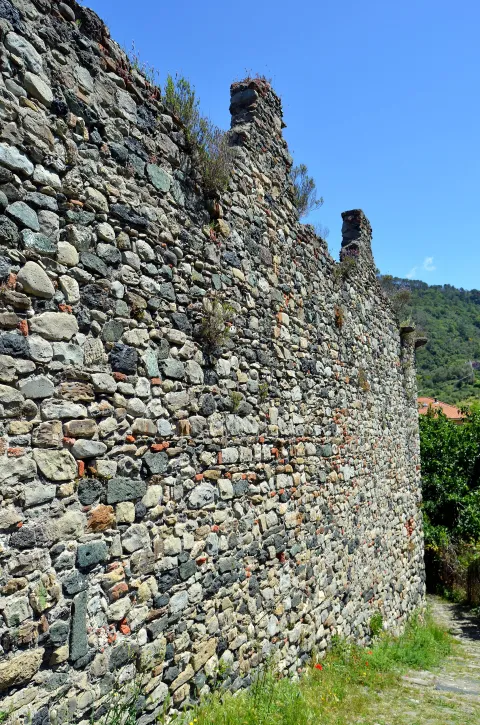
In 1610 the last religious left the Mesco and went down to Levanto, into the new Augustinian convent; from then on the church and the hermitage on the ridge fell into ruin. The first written mention dates from 1380, but analysis of the wall layers puts the earliest structure in the eleventh century, with an enlargement in dressed stone in the fifteenth. What survives is the apse, stretches of the vault and of the perimeter wall, and a few remains of the convent.
What to see
The Gothic masonry can still be read in the apse, the best preserved part: squared blocks, a clean curve against the sky, the rest of the wall dropping away until it merges with the scrub. Of the vault only the springings are left, of the perimeter wall broken stretches; of the hermitage built against the church there are low walls and the outlines of rooms, little more than a footprint. It is an honest ruin, never rebuilt, and should be looked at for what it is: four centuries of abandonment did the rest.
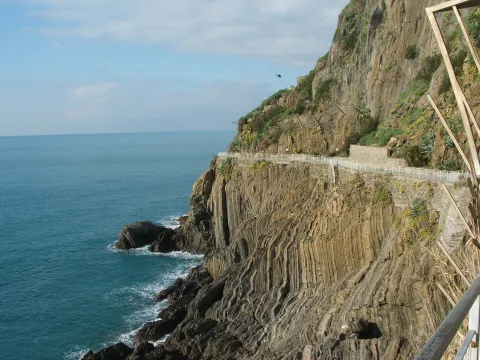
From the 311 metres of the plateau the eye covers a rare arc of coast: the Portofino headland to the west, the Cinque Terre to the east and, far off, the island of Palmaria in front of Porto Venere. The fifteenth-century statue of Saint Anthony the Abbot that stood up here is gone: it is kept in the oratory of the Morte e Orazione, in the old centre of Monterosso al Mare.
Visiting
You can only get here on foot, along the path that climbs through the woods towards Punta Mesco, on the boundary between Levanto and Monterosso al Mare; the hermitage itself lies in Levanto's territory. There are no opening hours and no tickets, the site is open air and always accessible, but the route is uphill throughout and proper walking shoes are needed. Bring water: there is nothing at the top, no fountain and no shelter, and the shade of the woods runs out before the plateau does.
Our editors' tip
We go up in late afternoon, when the light comes in low from the west and the sea below the point changes colour every few minutes. Put a small torch in your pocket, because the walk back through the woods turns dark sooner than you expect. And if time is left over, drop down to Monterosso to look for the statue that left the hermitage.