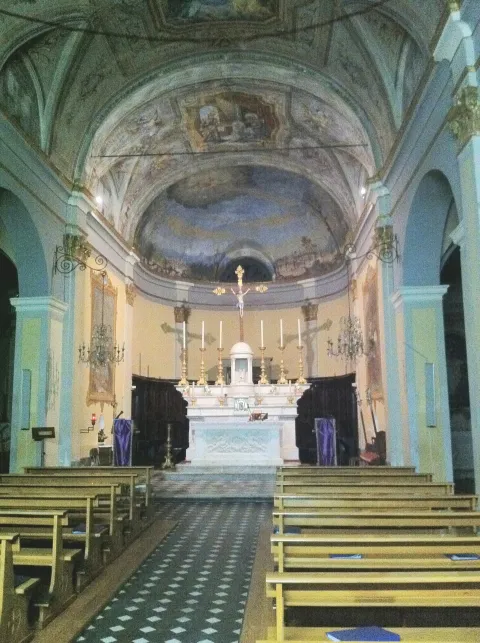
The church now standing on via XXV Aprile was paid for by a glassmaker. In 1650 the local master Matteo Buzzone had the present building raised and dedicated to the Santissima Annunziata, on the foundations of the old parish church: the first church in the village, built around the middle of the 12th century by the Benedictine monks of the monastery of Sant'Eugenio on the island of Bergeggi, who had held the fief of Altare since the 10th century and who are traditionally credited with bringing glassmaking here from France.
What to see
The original dedication was to Saint Eugene, then the patron of Altare: the Bergeggi community in turn depended on the abbey of Lérins, in Provence, and the saint's name travelled with the monks up into the hills behind Savona. The church was born with the village, as its first place of worship, and remained in use until 1600.
The village then built itself a new parish church, again dedicated to Sant'Eugenio, with work starting in 1620 in the old centre. The earlier church lost its rank but not its site: half a century later Buzzone rebuilt it from the ground up on the same footprint, changing its title to the Annunciation. That is why Altare has two main churches, one that inherited the parish role and one that keeps the oldest foundations. The building belongs to the diocese of Acqui, which the municipality answers to even though it lies in the province of Savona.
Visiting
Altare has just under two thousand inhabitants and sits eleven kilometres from Savona on the SS29 road over the Colle di Cadibona; the address is via XXV Aprile, and the centre is small enough that you will not need signposts. As a former parish church it keeps no regular opening hours: ordinary services are held in Sant'Eugenio, so aim for a celebration or ask at the parish office to get inside. Even from the outside the story is legible: a seventeenth-century fabric on medieval foundations, on the very spot where the Benedictines laid out the village.
Our editors' tip
We suggest pairing it with the Museo dell'Arte Vetraria in Villa Rosa: they are two ends of the same story. The monks who founded the church are the ones credited with bringing glass to Altare, and the man who paid for the seventeenth-century building was a master who had made his money at that trade. Taken in that order, church first and museum second, the old parish church stops being just another stop and becomes the signature of an economy.