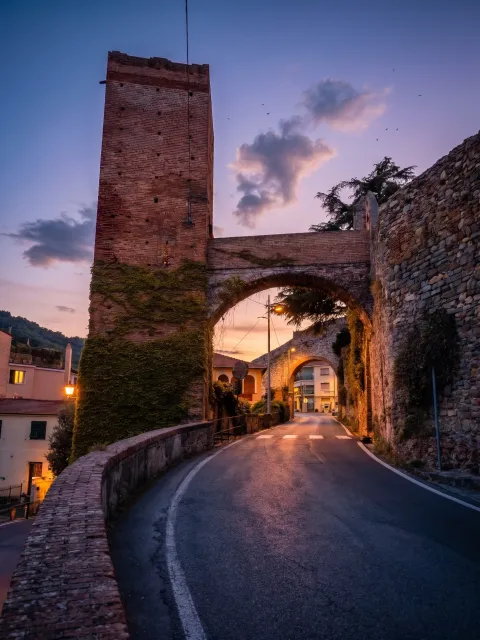
The castle gates were protected by an uncommon device: a tower set outside the wall circuit and linked to it by a masonry walkway, so that defenders could reach it and hit anyone pressing on the entrance from behind. Part of that system is still standing. The rest is the story of Noli, which after a fire around 900 abandoned the shore and rebuilt itself up here, on a hill that falls straight into the sea: by 1004 a document already describes it as a fortified borgo.
What to see
The oldest core sits at the summit: a tall cylindrical tower, the keep, ringed by heavy walls and by the quarters for the garrison. The keep belonged to an earlier fortification, the one built for the first hilltop Noli, and the building visible today was raised on its ruins in the age of the communes.
Two lines of wall run down from that core, preserved over long stretches, enclosing first the whole hill and then the settlement on the flat, which is the present historic centre. Circular towers follow one another at regular intervals along the walls as they descend the flanks of the hill. The final shape arrived around the fifteenth century and is owed above all to the Del Carretto, feudal lords of Noli: castle and circuit count among the best preserved examples of medieval castle-building in western Liguria.
Visiting
You walk up from the historic centre: the castle sits on top of the hill the walls climb, and the ascent is also the best reading of the whole fortification, because the circular towers come one after another and you see how the circuit gripped the slope. The height gain is short but steady, with rough footing in the last stretches. For access to the inner enclosure, ask in the village.
Our editors' tip
Once at the top, turn inland before you turn to the sea. From up there the garrison also watched the old Roman road that crossed the hills at Voze, in use until the eighteenth century: understanding that the castle faced both ways, coast and pass, explains its position better than any panel. Then come down along the circuit into the borgo without cutting corners, because the walls run right in among the houses.