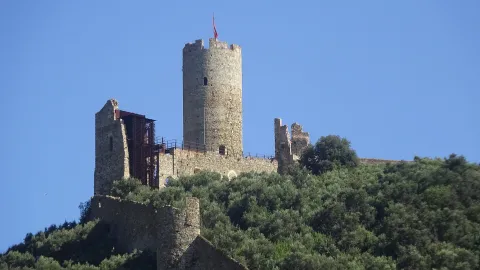
For centuries this was the Republic's powder store: the Torre di Papone, raised between the thirteenth and fourteenth centuries just outside Noli's older wall, held the weapons and ammunition of a small state that stayed formally independent from 1192 to 1797. A brick arch still ties it to the covered walkway coming down from the castle of Monte Ursino, and that joint says the rest: whoever held the hill held the road as well.
What to see
The windows are the surprise. Gothic two-light and single-light openings punctuate the walls, the sort of thing you expect on a lordly house rather than on a defensive work, evidence of a tower meant to protect and to be shown off at the same time. Beside it, the Porta Papona pierces the masonry and lets the road through: tower and gate are one organism, and locals still name them in the same breath.
During the thirteenth century Noli closed itself inside a ring of walls and equipped itself with more than seventy town towers. Nearly all have gone, lopped off or swallowed by later houses; the Papone is one of the few shafts still readable from top to bottom, along with the town hall tower and the Quattro Canti tower. Looking at it makes sense of a system that bound beach, wall and hillside into a single defensive plan.
Visiting
The tower stands at the northern edge of the old centre, on via Luigi Defferrari, a few minutes on foot from the arcaded front along the Aurelia. You take it in from the street, and it repays a full circuit: from one side the arch welding it to the walkway appears, from the other the shaft cuts clean against the green of the hill. The climb to the castle of Monte Ursino starts here too; its present shape dates from the 1552 rebuilding directed by captain Andrea da Bergamo.
Our editors' tip
Come at it from below, walking up through the carruggi instead of driving straight to the castle: the tower shows up in slices between the roofs, and only that way do you grasp how tall it stood over the village. Then keep going up to Monte Ursino, above the bay that closes to the east on the island of Bergeggi; on the way down the brick arch reads far better in late afternoon light.