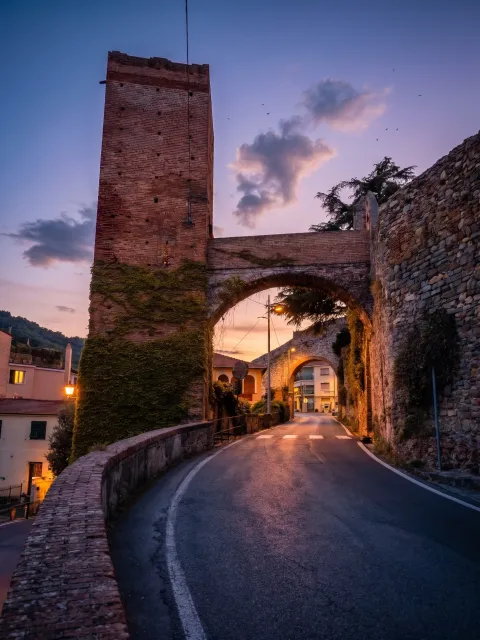
The recipe is the one used by every tower-house in Noli, and here you can read it straight up the wall: a plinth of large blocks of local green stone with few openings, and above it lighter brickwork pierced by two- and three-light windows. The Torre Pagliano forms a single body with the fourteenth-century house it belongs to, on corso Italia, and together they served as the seat of the Order of the Knights of Malta.
What to see
The change of material halfway up is not a flourish. The green stone quarried nearby carries the load and absorbs blows, while brick lightens the upper section and allows wide windows where defence is no longer the point. The same logic governs the town hall tower a little further on, and casa Repetto beside the co-cathedral of San Pietro, which also grew in the fourteenth century around a pre-existing tower.
Little medieval fabric survives inside. In 1906 a restoration entrusted to Angelo Demarchi, assistant to the architect Alfredo d'Andrade, thoroughly reworked the interiors, while the outer face kept its recognisable form. These were the years when d'Andrade and his school were going back over the Ligurian Middle Ages: their very interpretative idea of restoration is still legible across much of the old centre.
Visiting
The complex stands on corso Italia, in the tight built front of the old village, a few steps from the arcade that once opened straight onto the beach and now faces the Aurelia: it was the centre of the seafaring town, the local equivalent of what Sottoripa is for Genoa. You take it in from the street, and to see the tower whole you have to back up almost to the opposite pavement, because from close in the adjoining houses cut off its upper part.
Our editors' tip
Walk corso Italia twice, once in each direction and with your head up: going one way you count the two- and three-light windows, going the other you understand how the tower is wedged into the fabric of the houses. Then carry on to the loggia of the Republic, where plaques record the passage of Christopher Columbus on 31 May 1476 and of Giordano Bruno in 1576: a few minutes on foot, and the whole small state tells its story.