Locals still call it San Pietro dei Pescatori, Saint Peter of the Fishermen, and the name explains how it began: in the 13th century the first building was paid for with a tithe on the catch landed on feast days. It became a cathedral later, on 22 October 1572, when a bull of Gregory XIII moved the title here from San Paragorio, which stood outside the walls and too exposed to the Spanish troops that had taken the marquisate of Finale.
What to see
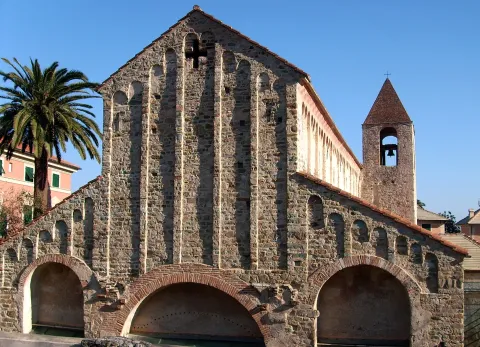
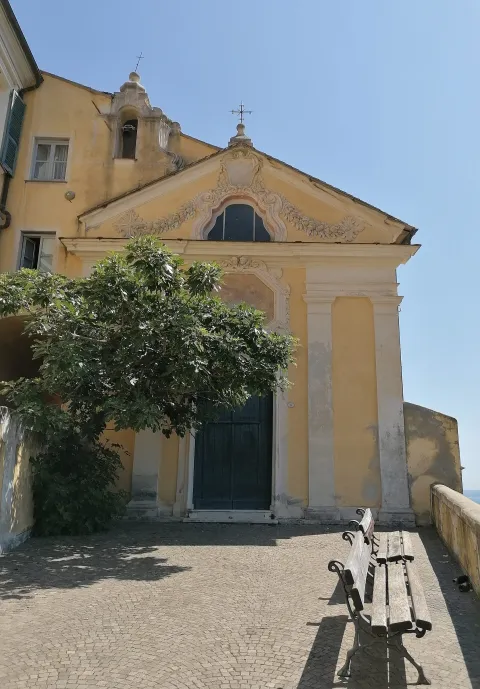
The church is a Romanesque body in Baroque clothes, and the two layers are easy to read: the narrow single-light windows on the side walls and the bases of the internal pillars belong to the 12th- and 13th-century site, everything else is Genoese and seventeenth-century. The central door dates from 1611; above it a broken pediment carries the statue of Saint Peter that Batta Casale set there in 1613. Inside are three naves with gilded stucco and coloured glass, a vault frescoed in the 20th century by Giovanni Rovero and, in the presbytery, 19th-century paintings by Lazzaro De Maestri.
The high altar of inlaid polychrome marble is the work of Anselmo Quadro, dated 1679; the pulpit is his too. The altar table itself, though, is a 4th-century African sarcophagus reworked in the 15th century, which held the relics of Saint Eugenius for centuries, brought here in 1602 after passing from the island of Bergeggi and then San Paragorio. On the left stands the ebony bishop's throne carved by Paolo Noceto in 1614; behind the altar hangs a 15th-century polyptych attributed to Vincenzo Foppa. In the right aisle an 18th-century wooden Annunciation is by Giovanni Battista Maragliano, a relative of the better-known Anton Maria.
Visiting
The entrance is on piazza della Cattedrale, in the middle of the old town and a short walk from the seafront: this is a working parish church, so it opens for services and often in the afternoon as well. Over the door, on the counter-facade, sits the Mascioni organ of 1909, heard occasionally during Mass. The Treasury is attached, with the reliquary of Saint Eugenius's arm dated 1430 in the inscription that names the patron, bishop Marco Vigerio, restored in 2017; it is not always open, so ask in the sacristy.
Our editors' tip
Look at the church from the floor up, starting with the pillars: they are the oldest part of the building and a reminder that the Baroque here is a coat, not the frame. Then give five minutes to the sarcophagus that serves as the altar table. A 4th-century piece from North Africa, reused as an altar, says more about how far the ships of Noli travelled than any label.