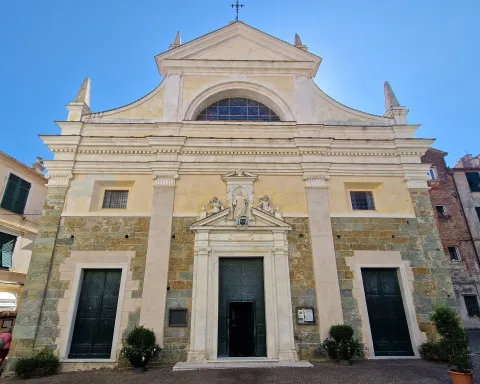
Under your feet at Spotorno there is a cemetery: the floor laid in 1751 in the church of the Santissima Annunziata opens onto 17 tombs, and the oldest carries the date 1582. The parish church, on via Giuseppe Garibaldi, is the mother church of the town: a first church dedicated to Saint Mary appears in documents as early as 1198, the present dedication is first recorded in a pastoral visit of 1585, and the reconsecration of 1694 closed the works that gave the building more or less its present shape.
What to see
Inside is a single barrel-vaulted nave with ten side chapels, not all of them with an altar, and two more flanking the presbytery. A carved wooden choir of the seventeenth century runs around the apse; on the counter-façade, above the entrance, stands a tribune of the same period, and on it the organ built in 1772 by the Genoese makers Filippo and Felice Piccaluga, rebuilt in 1906 by Italo Romoli, who however kept the eighteenth-century case and pipes.
The paintings are almost all seventeenth and eighteenth century, and the names are the good ones of the Genoese school: the Immaculate Conception by Giovanni Lorenzo Bertolotto, the Virgin and Child with Saints Peter and Paul by Giovanni Andrea De Ferrari, the Stories of the Virgin by Giovanni Agostino Ratti, the Virgin and Child between Saints Anthony of Padua and Francis that Domenico Piola signed in 1667. In the chapel of the Holy Crucifix the wooden crucifix is by Anton Maria Maragliano and stands out against Domenico Parodi's canvas of the Virgin, the Magdalene and Saint John mourning: sculpture and painting staged as a single scene.
Visiting
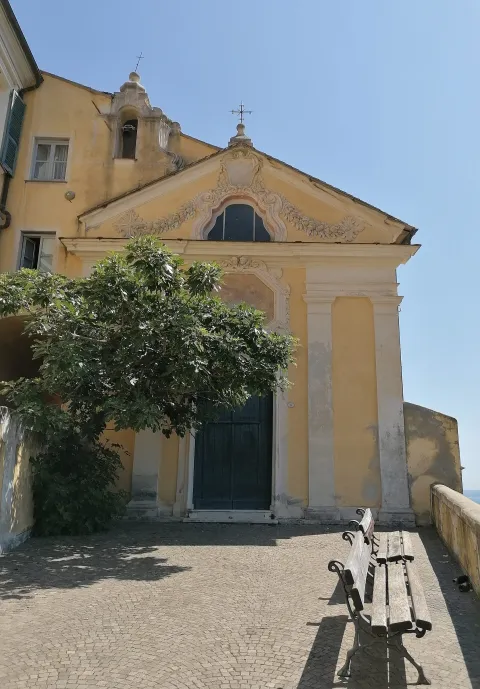
The church is in the old town, a short walk from the seafront, and it is a working parish: opening times follow the mass schedule and the door is usually open in the middle of the day. The nave is wide and the interior is dark: to see the paintings properly you need light, so mid-morning or early afternoon is better. Ask about the oratory of the Santissima Annunziata as well, which belongs to the same parish.
Our editors' tip
Stop for a couple of minutes on the threshold and think who has walked through it: in 1798 Napoleonic troops looted the church and its country chapels, carrying off more than 40 kg of silver, and on 16 February 1814 Pope Pius VII paused here for a few hours on his way back from France, where he had been Napoleon's prisoner. Sixteen years between the two episodes, the same man in the background. If you get the chance to hear the Piccaluga organ during a service, stay: it is the best thing in the church and the hardest to catch.