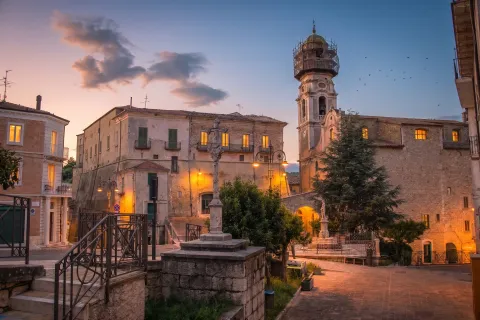
Visitors who arrive in the square looking for towers and battlements struggle to spot it: the castle of Limosano has been absorbed into the fabric of the old village, wedged against the houses that grew up around it, and is recognised mainly by the round-arched gateway that opens onto its courtyard. It is built from small stones, the same ones that pave the lanes of the historic centre: walk up on foot and you are already treading the material of the fortress.
What to see
The stronghold is thought to stand on an earlier Lombard outpost, with its present shape dating to the 13th century, or at least to the years when the nearby church of San Francesco was going up, commissioned by the Angevin lords in 1312. Three storeys rise straight from the rock of the hill, with no artificial foundations. The heart of the building is the square courtyard and its two facing stairways: the left-hand one climbs to the upper floors, where the castle stopped being a military machine and became a marchesi's palace, that is, a home. A second entrance, opposite the main gate, faces the small church of Santo Stefano at the highest point of the village.
Our editors' tip
The castle reads better once you know the order of its owners, because every handover left an alteration behind. After the Norman lords the fief changed hands repeatedly: in 1417 it was sold to the count of Campobasso, then to the Pandone, then to the Di Capua; in 1715 it went to auction and passed to the marchesi of Pietracatella, who sold it to the Venere family around 1806, when Bonaparte abolished feudalism. From then on the story of the village is one of emigration, to Ontario and the United States. Walk around the building from below, through the late-Renaissance quarter that grew at the foot of the palace: from there you see how much the fortress shaped the streets.