A confraternity of disciplini was attached to the church of Santa Marta, probably active already in the fifteenth century. What is certain is that around 1460 the brothers called in an unknown painter, known to scholars as the Master of the Passion, to decorate their church.
What to see
Fragments of that decoration remain, and they are the most interesting thing in the building: on the few stretches of medieval wall that survived the baroque rebuilding you can still make out processions of notables and common folk. The rest is eighteenth-century: work began in 1603 and in the first half of the following century the church was entirely rebuilt, taking the shape it has today.
Visiting
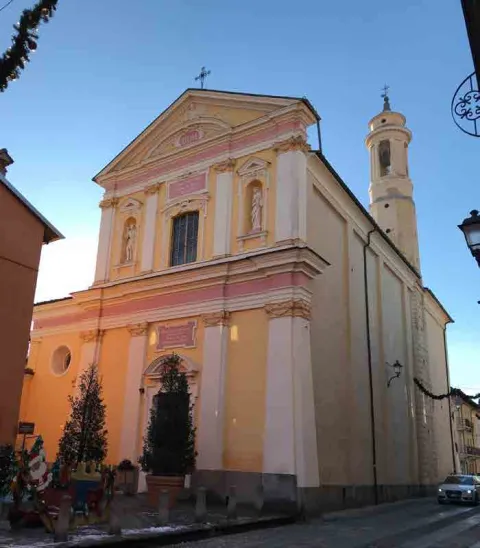
The neoclassical facade is the latest arrival, built in 1844 to a design by Pietro Delmastro, and it leads into an interior that has kept its original appearance almost intact: an airy, articulated space marked by pilasters and cornices. Two chapels open onto the central space; the left one keeps, in a niche, a much venerated wooden crucifix. The high altar and the polychrome marble balustrade are of Lombard workshop, as is the large wooden choir made for the brothers.
Our editors' tip
Look up at the central dome: the frescoes in the pendentives and in the bowl are by a painter who remained nameless, and they are the liveliest part of a decoration that is otherwise deliberately uniform, in soft tints. In the marble and stucco frame hangs instead the canvas of Saint Martha.