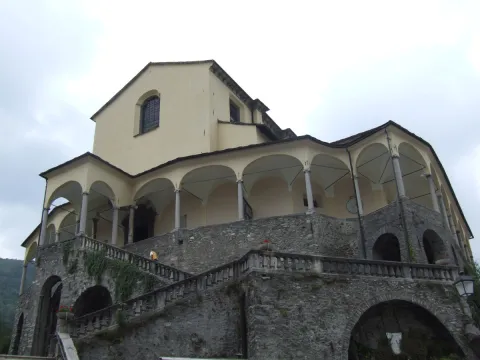
The sanctuary of the Madonna delle Grazie was built together with the Franciscan convent by father Bernardino Caimi between 1486 and 1493, in the very years when work was starting on the Sacro Monte. In December 1931 pope Pius XI raised it to the rank of minor basilica.
What to see
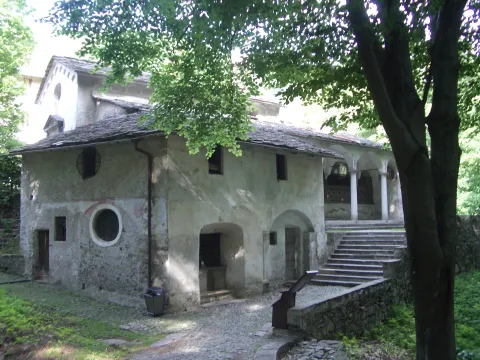
From outside the church is bare and gives nothing away. Inside, the style is Gothic and sober, with arches carrying the naked roof trusses, and the space is divided in two by a wall that reaches the ceiling, the tramezzo: it separates the hall of the faithful from that of the friars and rests on three round arches, the central one a passage and the two side ones filled by chapels. This is the so-called Bernardine module, said to have been laid down by Bernardino of Siena himself.
Visiting
On that wall Gaudenzio Ferrari painted in 1513 one of the masterpieces of Renaissance painting between Piedmont and Lombardy. It tells the Life and Passion of Christ over a surface of 10.4 metres by 8: twenty panels of equal size run from the Annunciation to the Resurrection, following the scheme of the Biblia pauperum, and at the centre a scene four times the size of the others pulls the eye towards it, the Crucifixion.
Our editors' tip
Around 1880 Jacob Burckhardt came through here and left with a phrase that works as a visiting instruction: what artistic splendour radiates from this wretched church. The convent, of which only a small part is now visible from the square with the monument to Gaudenzio Ferrari, had two cloisters, the library and the workrooms used for the building of the Sacro Monte; the Franciscans left it at the start of the twentieth century and since 1953 the complex belongs to the Missionary Sisters of Jesus Eternal Priest.