The special reserve is the wood on which the Sacro Monte stands, and as a protected area it dates from Piedmont regional law no. 12 of 22 March 1990. It is not a nature park in the usual sense: 33 per cent of the ground belongs to the municipality of Varallo, 26 per cent to legally recognised non-profit bodies and 41 per cent to private owners, and the boundary follows the crag that rises above the town. From the centre you climb by the carriage road, by the footpath that starts from the square named after Gaudenzio Ferrari, or by funicular.
What to see
The wood you walk through on the way up is not the one that was always here: the reserve's ground has been deeply altered over time and reached a state of partial abandonment, so work went into rebuilding the forest cover, above all its flowering component, with more than four hundred species handled, in order to bring the whole back to the look of a Renaissance garden. Among the trees you can pick out beech, box, yew, holly and field elm. The birdlife is the usual mountain kind, but heavy human pressure on the site makes it less remarkable than a wooded slope would lead you to hope.
Visiting
Management has changed hands more than once: first to the civil administration of the holy site under regional law no. 30 of 28 April 1980, then to the municipality of Varallo under law no. 18 of 12 September 1985, and finally to the public body that carries the reserve's name. On the religious side, an agreement signed on 10 April 1989 between the Valsesian municipality and the episcopal administration of Novara entrusts the religious running of the site to the Oblate fathers. The registered office is in piazza della Basilica, at Casa Valgrana; the information office, the rangers' office, the conference hall, a small guesthouse, a library and a herbarium are instead at the Casa d'Adda service centre, where the carriage road arrives. Guided visits, for a fee, are booked at the Varallo tourist office and led by the Valsesia association of nature guides.
Our editors' tip
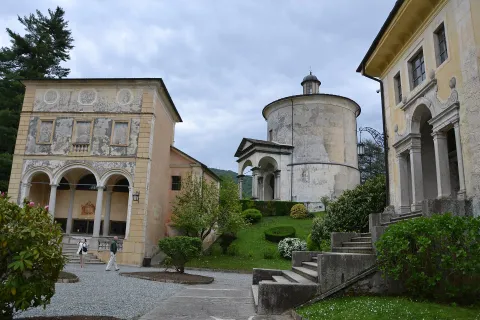
If you have the time, walk up from piazza Gaudenzio Ferrari and keep the funicular for the way down: it is the only way to grasp that the reserve and the sanctuary are one and the same thing. The chapels appear among the trunks one at a time, and the wood between them is not a backdrop but part of the design, exactly what the work on the forest cover set out to recover, with the Renaissance garden in mind. Anyone arriving with a school class or a society can ask about the teaching programme: the reserve runs film screenings and lessons on ecology, natural history and history, and provides indoor and outdoor picnic areas for the break.