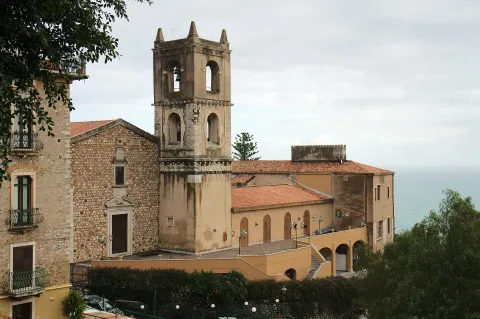
Built directly over the ancient Greek Temple of Zeus Serapis on Salita San Pancrazio, the Church of St. Pancras stands on grounds documented by 18th- and 19th-century discoveries, including a priest's engraved gold ring unearthed in 1742 and a statue of a priestess of Isis. The sanctuary survived three Saracen sieges before being remodeled into its present Baroque form during the second half of the 17th century.
What to see
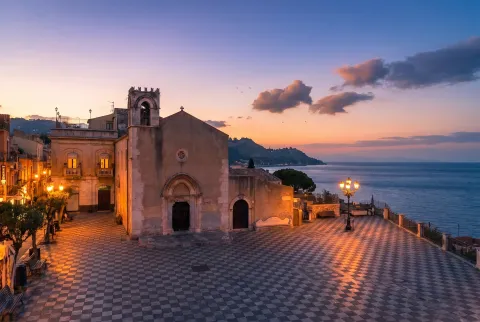
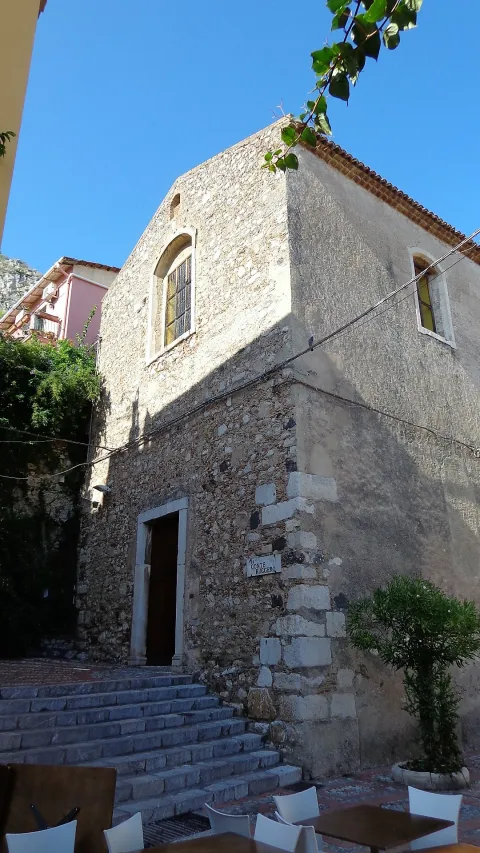
The exterior offers a clear view of the site's multi-layered history: the southern wall incorporates the squared-stone masonry of the ancient Greek cella, complete with original walled-up windows, sills, and lintels. The east-facing facade features a monumental white-and-pink mottled marble Baroque portal, framed by Ionic columns and Corinthian capitals above four Taormina stone steps. Niches flank the entrance: on the right stands Bishop St. Procopius holding his heart in his hand—referencing his martyrdom during the Saracen assault led by Ibrāhīm ibn Ahmed on August 1, 902—while the left niche features a bishop figure representing St. Pancras or his successor St. Maximus. Above the sacristy, the stone bell tower rises with an upper tier of four round arches, crowned by an octagonal lantern, dome, and double-volute battlements.
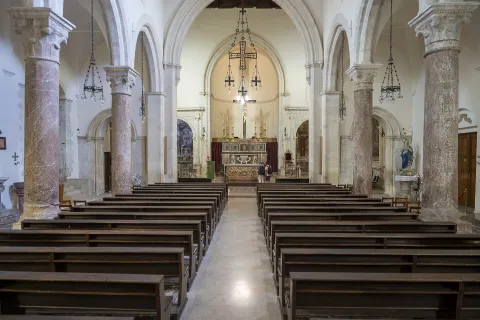
Inside, the single-nave interior contains significant 18th-century artworks. The right wall houses the Chapel of St. Nicon, showcasing a painting by Ludovico Suirech depicting the beheading of St. Nicon and 99 religious figures, alongside the Chapel of St. Maximus, featuring Suirech's 1768 canvas of St. Peter consecrating Bishop Maximus. The left wall holds the Chapel of St. Procopius, with another martyrdom scene by Suirech, and the Chapel of the Holy Crucifix. The Baroque presbytery occupies the Greek temple cella and holds the processional float of St. Pancras beneath a marble canopy with putti and a relief of the Virgin and Child. Frescoes frame the main altar: one depicts St. Pancras's martyrdom at the hands of Arcagano, while the other shows his arrival at Naxos causing the destruction of pagan idols.
Our editors' tip
Take time to inspect the church's southern exterior wall. The large, squared stone blocks of the original Hellenistic cella stand out distinctly against the 17th-century Baroque additions, providing a rare visible record of classic Greek architecture adapted for Christian worship.