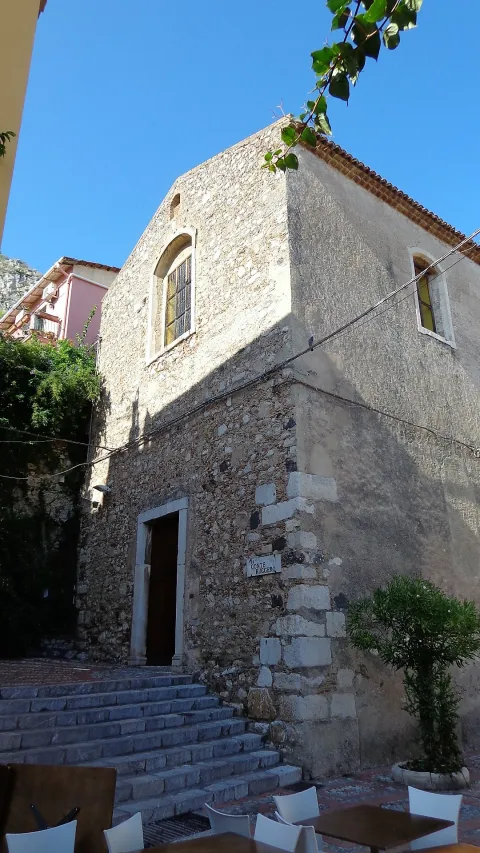
In 1486, the citizens of Taormina built a church dedicated to Saint Sebastian as a vow of gratitude for deliverance from the plague. Located just outside Porta dell'Orologio in Piazza IX Aprile, the structure was granted to the Augustinian Hermits on September 12, 1530, under the supervision of Viceroy Gaspare de Spes, later confirmed by Ettore Pignatelli and Archbishop Antonio La Lignanime. Renamed after Saint Augustine of Hippo, the complex was expropriated by the municipality in 1866. Following comprehensive restoration in 1981, it reopened in 1985 to serve as a library and multi-purpose venue.
What to see
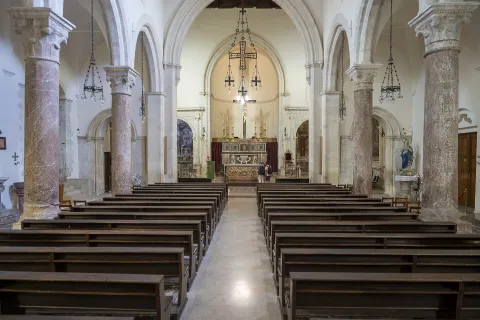
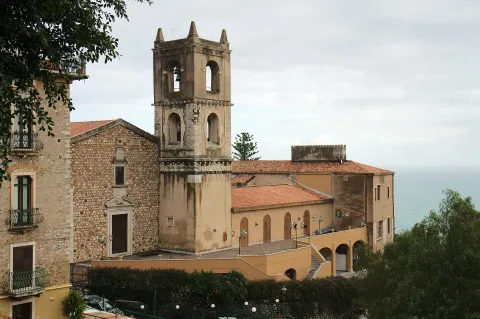
The original late Sicilian Gothic facade retains its small rose window and the pointed arch portal, which was modified in the 18th century with a large Taormina marble lintel and stone quoins. To the left stands a tower-like bell tower adorned with battlements, a pointed arch bell chamber, and black lava stone inlays. A portal on the right provides entry to the former convent. Inside, the single hall features a wooden trussed ceiling and four niches on each side wall decorated with painted Corinthian columns and faux arches. The church historically housed a 1504 polyptych by Antonello de Saliba—a six-panel tempera work set in an inlaid wooden retable by Pietro or Giovanni de Saliba—which is now held in the Cathedral of San Nicola di Bari in Taormina.
Visiting
Since 2011, the former convent has operated as Taormina's civic library. Its collections exceed 22,000 volumes, including 2,000 titles focused on Sicily and an ancient fund of theological, philosophical, and scientific treatises sourced from local Augustinian, Dominican, and Capuchin monasteries. The former refectory serves as the main reading room, while the hall named after legal scholar Giovanni Di Giovanni hosts art exhibitions.
Our editors' tip
Examine the exterior of the small bell tower on the left of the facade to appreciate the precise decorative patterns crafted from lava stone inlays.