Above the entrance portal a coat of arms carries the date 1793: the signature of Bishop Francesco Vanni, a Theatine who led the diocese from 1789 to 1803 and closed a building site opened two centuries earlier. The layout of the palace goes back to Francesco Gonzaga, a Franciscan, bishop of Cefalù from 1587 to 1593; Vanni finished the job, giving the building the shape of an eighteenth-century gentleman's residence, which is what you see today. The see itself is as old as the diocese, re-established in 1131 at the request of Roger II.
What to see
The best part is the courtyard, onto which three internal facades look. The rhythm comes from the balconies, framed in tufa, with crownings that alternate: one pedimented, the next arched, and so on along all three sides. The fourth side, the one with the portal, is a low block roofed as a terrace, linking the palace to the seminary next door, founded by Gonzaga himself. A floor added in recent years has weighed the whole thing down; look up and you notice it.
Inside, the cathedral's guided routes cross some of the palace rooms, among them the bishop's chapel and the Sansoni hall with its frescoed ceiling, and they take in the chapter house, where the diocesan museum displays the cathedral treasury: more than a hundred pieces, silverware, vestments and liturgical furnishings. The canons' cloister closes the circuit.
Visiting
The palace stands on one side of Piazza del Duomo and cannot be visited on its own: it is the bishop's residence, and its rooms are seen only within the cathedral itineraries, run under agreement with the diocese. The fullest route, the red one, strings together the towers and roofs on the south side of the basilica, the sacristy, the diocesan museum, the palace with its chapel and the cloister; the green route skips the towers and stays in the museum area. Tickets are sold at the basilica entrance and cost around ten euros; the long circuit takes a good hour, narrow stairs included. The cathedral has been a UNESCO site since 2015 along with the other Arab-Norman monuments.
Our editors' tip
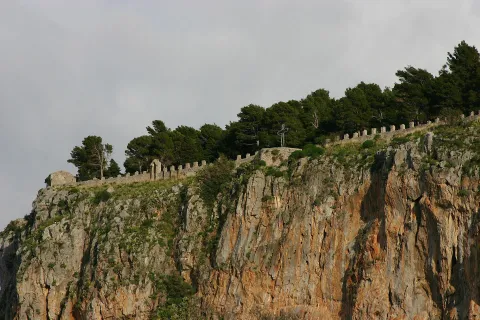
We take the red itinerary in the late afternoon, when the low light on the roofs cuts the Rocca out against the sky and the heat has gone. And before leaving we go back into the courtyard: almost everyone walks across it looking straight ahead, while the good part is over their heads, in that row of balconies that changes its crowning at every bay.