In the second half of the 19th century the owners wanted a second floor and, to reach it, they covered the pietra lumachella staircase that climbed to the piano nobile with a new flight of steps; the square courtyard with its well, the centre of the house from the start, was largely built over in the process. The palace facing piazza del Duomo in Cefalù still carries that alteration, and with it four centuries of families who passed it from hand to hand.
What to see
The original building dates from the 15th and 16th centuries and is the work of the Burragato family. In the 1500s the Ruffino family enlarged it by absorbing neighbouring houses, a common practice in Sicilian old towns, where noble palaces grew by buying out the people next door. At first it was limited to the piano nobile and was arranged around the large square courtyard with a well, served by the staircase in pietra lumachella, a limestone full of fossil shells that raking light picks out one by one in the block.
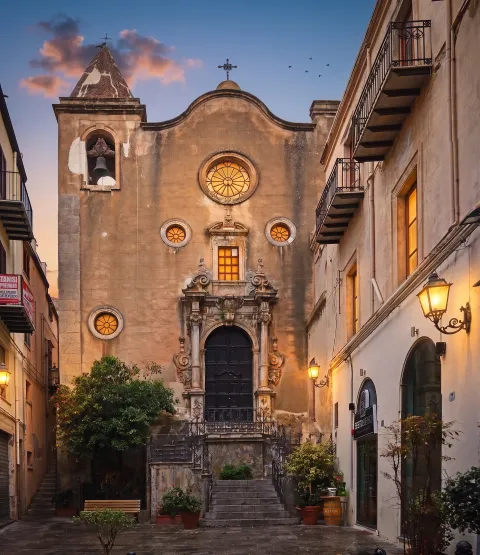
On the front the tuff portal survives, added in the 19th century when the house was raised. In the entrance passage of the courtyard, 16th-century frescoes have been brought back to light by recent work: they are the most direct evidence of how the building was decorated before the alterations. The list of owners is written into the name: towards the end of the 18th century the palace passed to Casimira Martino Valdina, baroness of Rocca e Valdina, wife of Luigi Atenasio Battifora e Traverso, baron of Montededero; it then went by inheritance to her daughter Giuseppina Atenasio and, by will, to Giovanna Cerami Atenasio De Spucches, who married Girolamo Maranto, professor and mayor of Cefalù. The Maranto heirs still own it.
Visiting
This is a private home: no ticket office, no opening hours, and what you see is the front on the square with its 19th-century portal. Look at it from the cathedral forecourt, raised by a few steps, which gives the best view of the whole row of buildings. Ten minutes are enough, folded into a visit to the Norman cathedral begun by Roger II in 1131, whose apse mosaics were made by Byzantine craftsmen in 1145 and which has belonged since 2015 to the UNESCO site of Arab-Norman Palermo. The square is pedestrian and can be reached on foot from anywhere in the old town.
Our editors' tip
Come to piazza del Duomo early in the morning, before the café tables take over the space: the light rakes across the façades and you can read the blocks of the tuff portal one by one. If you find the door open, the courtyard is visible from the entrance passage — ask politely before stepping in, because someone lives here. To go further, the survey of Cefalù's cultural heritage compiled by A. Tullio in 1989 remains the reference on this palace and the others on the square.