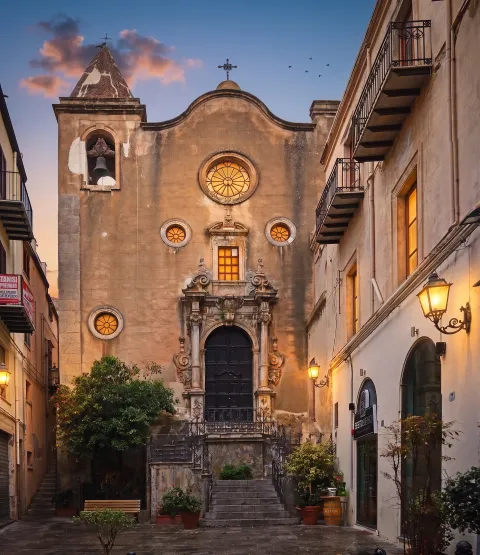
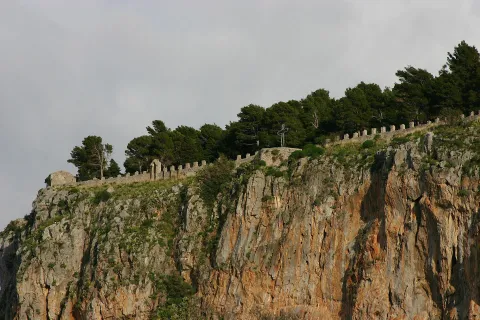
For centuries the people of Cefalù called it the Domus Regia, the house of Roger II, but the palace standing today is the work of the Ventimiglia del Maro, counts of Geraci and later princes of Castelbuono, who in the thirteenth century reworked earlier Norman structures. The oldest document naming it is the will of 8 January 1387, in which count Francesco II Ventimiglia left everything to his son Enrico III. The family held it until 1602, when Giovanni III Ventimiglia sold it to Simone de Flore; after his death in 1603 the heirs passed it to the Dominicans, who broke it up into houses, shops, warehouses and even a jail.
What to see
On Via Amendola stands the two-tone wing, alternating bands of pale tufa and black lava stone, with three fine paired windows in a row: the most photographed part, and the oldest after the tower. On Corso Ruggero instead opens the great three-light window, Chiaramonte in taste like the paired windows on the other front, lighting a solemn hall; inside it survives the small lintelled door carrying the arms of the Ventimiglia del Maro, and the echo of Palazzo Chiaramonte in Palermo is plain.
The square tower tells the stratigraphy of the site: the lower courses are Norman and rest on Greek blocks, the three-storey heightening was carried out between 1320 and 1330, and the top once had machicolations, now lost. A ground-floor room keeps the remains of a cistern, probably Roman. The restoration run from 1988 to 1991 by the architect Silvana Braida, with excavations by Amedeo Tullio, brought to light Hellenistic houses, bronze coins of the fourth century BC and a parade basin with a heraldic lion of the fourteenth century.
Visiting
You go in from Corso Ruggero, halfway along the main walk of the old town. The building belongs to the Region today and works as a venue for exhibitions and conferences: what is on show changes from season to season, while the constant is the building itself. The ticket costs a couple of euros and is included in the cathedral itineraries; opening hours are split between morning and afternoon, with the usual break. Twenty minutes or half an hour is enough, more if a show is running. The rooms are bare, with no furniture: you look at the walls.
Our editors' tip
Before going in we walk round the block and take Via Amendola: from there the banded black-and-white front reads whole, which is impossible from the Corso, where the crowd and the shop windows eat up the distance. Then, inside, we look for the point where the masonry changes: Greek squared stone at the bottom, Normans above, Ventimiglia above them again. Three ages in two metres of wall.