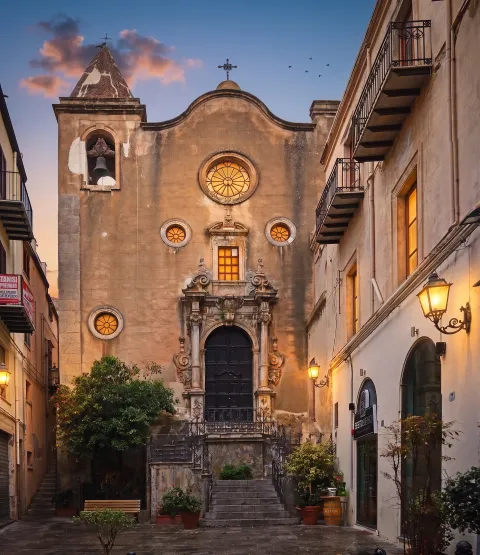
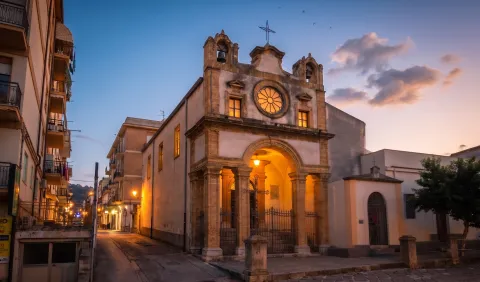
On Via Umberto I, in Cefalù's Borgo district, this church was built in 1686 at the behest of Monsignor Pietro Cimino, dean of the cathedral and a member of the tribunal of the Inquisition. The plot already had a devotional past: a chapel dedicated to Saint Vitus stood here before the present building replaced it.
Most people walk straight past. In a town whose skyline belongs to a great Norman cathedral, a plain late seventeenth-century front does not compete for attention — and that is precisely its point. The foundation records the moment when the neighbourhood that had grown along the main road, outside the oldest core, received a church of its own, paid for by one of the cathedral's senior clergymen.
What to see
The exterior keeps to smooth plaster with only the simplest decoration. Inside, a single nave runs under a timber trussed roof, and the walls preserve a cycle of seventeenth-century frescoes — contemporary with the church's founding, or nearly so, and the building's main claim on your time.
Notice also how the church meets the street: it opens directly onto Via Umberto I with no churchyard in front, as was usual for buildings inserted into an already built-up quarter, where every metre of frontage on the main road already had an owner and a use.
Visiting
Ten minutes will do, folded into a walk along Via Umberto I between the old town and the modern one. Like many smaller Sicilian churches it keeps no guaranteed opening hours; your best chance of finding the door unlocked is around service times. Even when closed, the facade and its urban setting reward a short pause on the way through the Borgo.
Our editors' tip
Since the founder was dean of the cathedral, pair the two buildings in a single morning: start at the duomo with its twelfth-century Norman mosaics, then walk down to the Borgo. The distance between Byzantine gold and bare Baroque plaster compresses five centuries of Cefalù's religious history into a fifteen-minute stroll.