Beneath the present church lies a crypt used as a Christian burial ground as early as 250 AD, when the first believers of Mazara came here to pray and to shelter from persecution. On that ancient core, in 1093, Roger I of Hauteville had a basilica raised and dedicated to Saint Blaise, built in Arab-Norman style with three naves and twelve altars. The Franciscans arrived in 1216, when Blessed Angelo Tancredi of Rieti, summoned to Sicily under Frederick II, founded a friary beside the church of Saint Blaise.
What to see
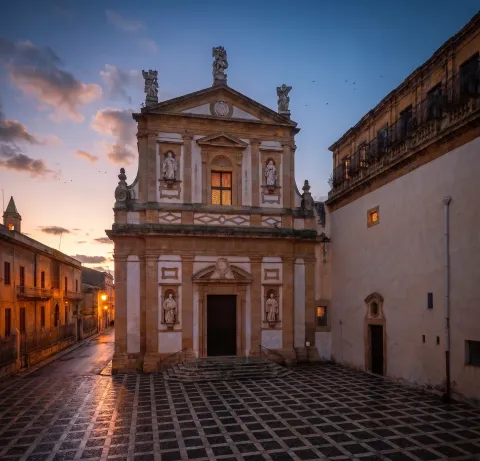
The plastered facade, facing southwest, is framed by tall ashlar pilasters rounded at the corners. Its centrepiece is the portal, signed by Leonardo Incrivaglia in 1730: two columns on high plinths, their shafts smooth for two thirds and set on a twisted base wrapped in a spiral festoon, carry a scrolled pediment. In the roundel above the doorway a relief shows Saint Francis receiving the stigmata, crowned by an aedicule holding a statue of the Immaculate Conception. On the side walls you can still read the arches of the Norman naves, later walled up. Inside, the single hall is startling in the sheer wealth of its stuccowork, attributed to the Orlando workshop: allegories of the cardinal and theological virtues take the form of full-round female figures set in niches between the arches, while busts of Franciscan martyr saints run along the cornice amid crowds of putti. The fresco cycle is the work of Giovanni Battista Scannatella, and a series of paintings hangs in the side altars. On the counter-facade, a wooden choir loft opens onto an arch decorated with music-making angels in stucco.
Visiting
The building's present look was a deliberate choice. In 1680 Monsignor Francesco Maria Grifeo, the future bishop of Mazara del Vallo, set out to recast the old church in the Baroque taste: the two side naves were pulled down, and the central nave was raised and covered with a barrel vault. The church reopened for worship in 1703. The 1968 Belice earthquake badly damaged both church and friary; restoration, begun in 1977, ended with the reopening for worship on 15 March 2019. Next door, the convent is worth your time, with its rectangular arcaded cloister, cross vaults and a fountain at the centre of the courtyard. After the suppression of religious orders in 1866 it was seized and put to civic use: it served as the local Carabinieri barracks and even as a women's prison until 1970, before its recent recovery.
Our editors' tip
Do not stop at the nave: the oldest story is underground. Ask to go down into the crypt, where the third-century burial ground speaks of the city's Christian beginnings long before the Baroque you see above. Then step out to the convent: the cloister with its fountain is the quietest corner of the whole complex.