The crypt of the pieve of San Giorgio holds the two carved stone tombs of the lords of Dolceacqua: on the left Stefano Doria, dated 1580, on the right Giulio Doria, of 1608. They were installed here between the sixteenth and the seventeenth century, in a space far older than they are: the church was almost certainly founded in the tenth century by Benedictine monks, who wanted it outside the built-up area, where the cemetery still lies today. Its rank as a pieve says the rest: this is where the font stood, the one the smaller churches of the district depended on.
What to see
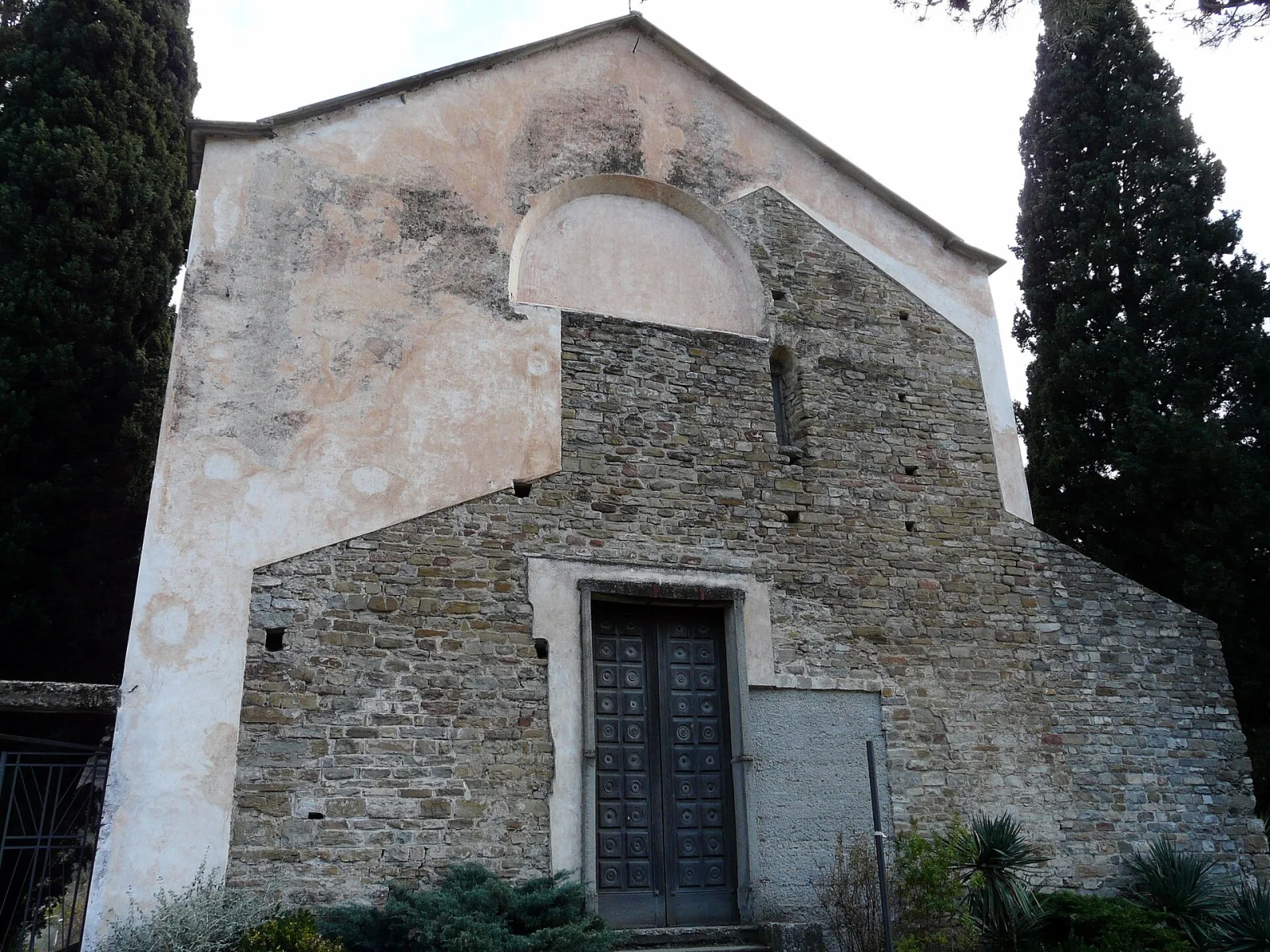
The façade tells the story of two building sites in a single wall. Top left you can read the Gothic phase of the fourteenth century; on the right, and at the base of the bell tower, the Romanesque masonry of the eleventh century survives. It is rare to be able to compare the two so closely, a few metres apart, before even going in.
Inside, the layering continues. The Romanesque church divided the hall into three aisles, while the Gothic rebuilding went back to a single, wider nave, adding the polygonal apse and the new crypt. The high altar is raised directly above that crypt and is reached by two side staircases. The small dome capping the bell tower, by contrast, is a Baroque addition.
Visiting
The church stands on via Roma, just outside the old centre, in the cemetery area: from the bridge over the Nervia it is a few minutes on foot. It is not the village parish church and has no continuous opening hours; access depends on services and local events, so it is worth asking in the village before setting off.
Our editors' tip
Ask to go down into the crypt: it is the most intact space in the building, and the point where the Doria story stops being a matter of castles and sieges and becomes a family affair, with two stone slabs facing each other.