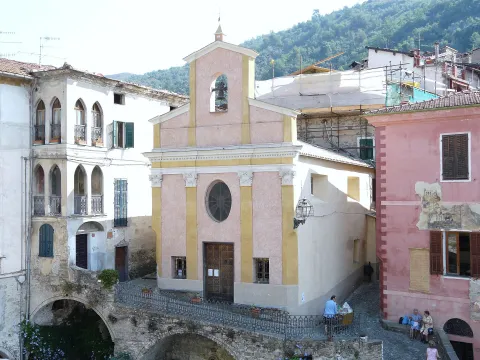
In 1151 a bull of Pope Eugene III confirmed the priory of Santa Maria della Mota, outside the built-up area of Dolceacqua, as a dependency of the abbey of Novalesa in the Val Susa: the same year the village itself first appears in an official document. The Benedictine house, founded in the Carolingian period, controlled many churches and landholdings in the Val Nervia, and it was its monks who spread olive growing here and improved the working of the vine.
What to see
Of the monastery, also recorded as Santa Maria de Muta, only ruins are left: the complex was destroyed in 1744, during the War of the Austrian Succession, the same conflict that on 27 July of that year cost the Doria castle partial destruction and surrender to Franco-Spanish troops. Nobody has rebuilt it since.
Its ownership reads like a list of monastic removals: from the Benedictines of Novalesa to those of the abbey of San Pietro di Breme in the Lomellina, then to the monastery of San Pietro di Vasco near Mondovì, then to the Carthusians of the Certosa di Pesio in the Cuneo hills, who already held the fief of Airole. In 1446 the site passed to the Doria, lords of Dolceacqua, who in 1623 gave it to the Discalced Augustinians of the Genoese convent of Nostra Signora della Consolazione e San Vincenzo martire.
Visiting
This is not a museum site: it stands outside the built-up area, with no opening hours, no ticket desk and no custodian, and it is listed in the Italian Ministry of Culture's general catalogue of heritage. What you find is a ruin in the open country of the Val Nervia, among olive terraces and vines that are, in the end, the most concrete legacy of those monks. Wear closed shoes and watch your footing: nothing here has been laid out for visitors.
Our editors' tip
We save it for the end of a morning in the village, after the castle and the bridge: the thread tying the priory to the rest of Dolceacqua becomes much clearer that way. And we close the day at table, with a glass of Rossese di Dolceacqua and a little taggiasca oil. The vine and the olive that the monks of the Mota brought into this valley are the only part of their work still alive.