Set into the wall of the main apse, above a row of small blind arches, ceramic bowls from Sicily or North Africa have been in place since about 1050 - among the oldest walled bowls in Liguria. The ones on view are copies; the originals were taken down for conservation. San Paragorio stands outside the medieval walls of Noli, served as the town's cathedral until 1572 and has been an Italian national monument since 1890.
What to see
The building is Ligurian Romanesque of the 11th century, raised over an earlier Palaeochristian church: three naves, heavy piers, semicircular apses, thin pilaster strips framing the blind arcading and paired across the front. The door is not on the facade but on the left flank, under a Gothic porch of stone and brick carried by two columns; the portal alternates white and black stone, the Ligurian way of marking a threshold. Two monumental arcosolium tombs stand to the left, and to the right of the porch lies the slab of Gandolfo De Gasco, dated 1272 by its Gothic inscription.
Inside, the high altar carries a painted wooden crucifix from the second half of the 13th century, a relative of the Volto Santo in Lucca: Christ wears the long tunic, the colobium, following an Eastern model. Beside it is a copy of the bishop's throne of 1239, with a Genoese bishop's crest cut into the back. Fifteenth-century frescoes survive in the presbytery niches, and in the side aisles a panel by Teramo Piaggio shows Saint Paragorius on horseback with Parteo, Partenopeo and Severino. Stairs on either side of the presbytery lead down to the crypt, once the floor of two small chapels of the 4th and 5th centuries; the medieval builders reused Roman monolithic columns down there.
Visiting
You reach it on foot from the old town: the church sits just beyond the medieval circuit, alone on a grassy plot, with Palaeochristian sarcophagi lined up along the boundary wall. The ground around it was dug in 1972 by Nino Lamboglia, who brought back a late-antique necropolis and a baptistery; later campaigns found traces of a craftsmen's quarter. Opening is not continuous and changes with the season, so check with the town hall or the museum before setting out: with the doors shut only the exterior can be seen, though that alone repays the walk.
Our editors' tip
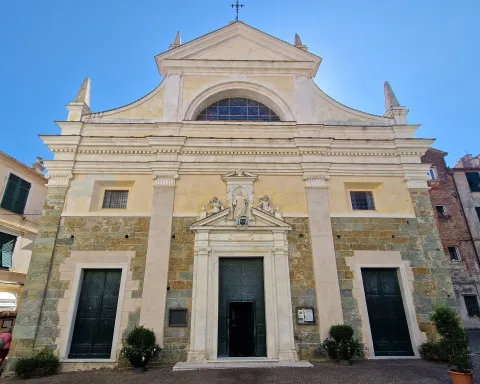
Bring binoculars or a long lens. The bowls sit high up, between the arcaded frieze and the eaves, and the naked eye loses them. Then walk back up into town to the co-cathedral of San Pietro. The title moved there in 1572 because San Paragorio, outside the walls, was too exposed; seeing both churches in one morning explains that move better than any caption.