It was born out of a village quarrel. In 1582 part of the community of Sassello commissioned the Swiss architect Antonio Martino Bertolle of Locarno to design a new church, meaning to make it the parish church of the village; the other inhabitants, attached to the older parish of San Giovanni Battista, opposed the plan fiercely. The church was built anyway, perhaps on the site of a chapel dedicated to Santa Maria recorded from 1512, and was dedicated to the Visitation. The title changed on 8 May 1622, when the bishop of Acqui, Gregorio Pedrocca, consecrated it as the basilica of the Immaculate Conception.
What to see
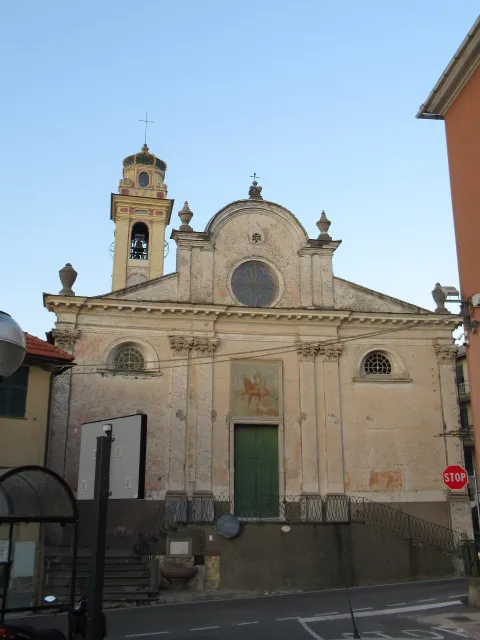
The building is 40 metres long and 18 wide, with three naves and a bell tower of 1643 standing 30 metres high. There are no frescoes: light comes in through the coloured glass windows and the work is left to the paintings and the sculpture. The façade is divided into three by false pilasters and carries three statues, San Giovanni Battista, Sant'Antonio and, above the main door, a Madonna and Child with angels of 1641.
Inside, in late Renaissance forms, half of Genoese painting lines up: canvases by Orazio De Ferrari and by Agostino Ratti, who in 1730 signed a Saint Francis adoring Jesus and the Virgin, works by Paolo Gerolamo Piola and Giovanni Raffaele Badaracco, the Virgin handing the Child to Sant'Antonio by Lorenzo De Ferrari, the Dream of Jacob and the Healing of the Blind Man by Giovanni Battista Tassara. Then there is the crucifix by Brilla, the San Filippo Neri by Gio Batta Rebagliati, wooden sculpture by Domenico Canepa and Pasquale Navone, and an eighteenth-century organ.
Visiting
The basilica stands in piazza Concezione, in the old centre, facing palazzo Doria-Perrando, today the town hall; you can walk there from anywhere in the village. The building next to it is the former Franciscan friary, begun in 1613 and now a carabinieri barracks: the friars left in 1860, after a forced interruption between 1810 and 1829 imposed by Napoleonic law. Since 1956 the basilica has been in the care of the local confraternities, who open it for services and for their own celebrations.
Our editors' tip
We would aim for Corpus Christi: for the infiorata the streets and squares of the old centre are covered with designs made from thousands of flower petals, and the square in front of the basilica is one of the places where the work shows best. If you come on an ordinary day, go in anyway and look for the two Tassara canvases: they are the quickest way to grasp how far Genoese patronage reached into this inland village.