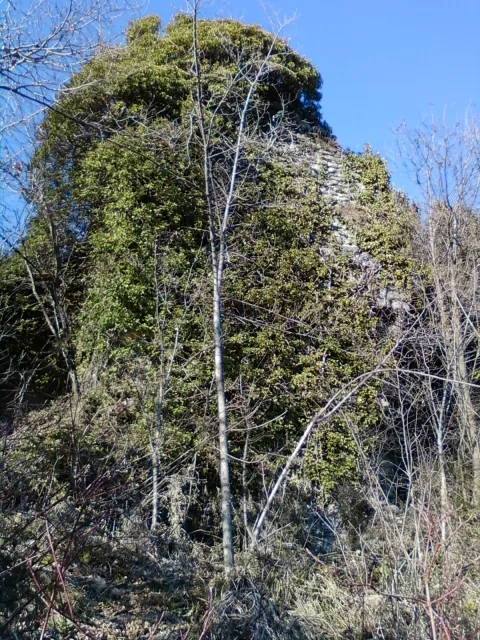
Of the fortress Branca Doria had built above Sassello, what still stands is mainly a round tower, rising out of the scrub on a rise east of the village, barely a kilometre from the old centre. The castle went up in the second half of the 13th century: Branca Doria, the Genoese who proclaimed himself lord of Sassello without any official investiture and whom Dante names in a canto of the Inferno, planted it where a watchtower already stood, put there to guard the first core of Sassello, gathered on a hillock in a bend of the rio Sbruggia.
What to see
What is left is quickly counted: shreds of wall from the central body, a small underground room now almost entirely buried, and the tower, known as “Saracena”. Its state of preservation is poor and nothing can be entered; the value of the place is in the position, which on its own explains why the castle stood there: from that rise you kept an eye on the old village and the valley.
The castle was destroyed outright, and with it the settlement it defended; Sassello was later rebuilt further down, where it stands today. The military history of the town moved with it: around 1450 Filippo Doria had a new fortification raised lower down, near Bastia Sottana, of which scant wall remains survive close to the houses. The two Bastie, Soprana and Sottana, tell the same story when you see one after the other.
Visiting
Sassello is reached by the strada statale 334 del Sassello, which comes down from Pareto and Ponzone and climbs from Pontinvrea and Stella; the town sits inside the Parco naturale regionale del Beigua and is crossed by the Erro stream. The ruins have no ticket office, no opening hours and no custodian: they stand on a wooded rise east of the houses, a few minutes' walk from the centre. The masonry is unstable, so look at it from a safe distance.
Our editors' tip
We go in winter or early spring, when the brambles are low and the tower separates from the wood: from May onwards the vegetation hides it almost completely. We suggest lining up the two Bastie in the same morning, Soprana first and then Sottana, and closing the loop in the centre of Sassello: it is the quickest way to understand how and why the town changed altitude.