Outside the centre of Bojano, in the Piaggia district, on the road climbing towards Civita Superiore, this church is built largely from stones older than itself. It very probably goes back to the sixth century and reused material from a Roman temple dedicated to Bacchus: decorative pieces from the first century can be picked out in the walls and, to the right of the entrance, among the Roman reliefs embedded in the masonry, one shows a woman with branches sprouting from her arms. The overall look is medieval, but the first written mention comes late, in 1623, when Ottaviano Garzadori, bishop of Bojano, paid it a visit.
What to see
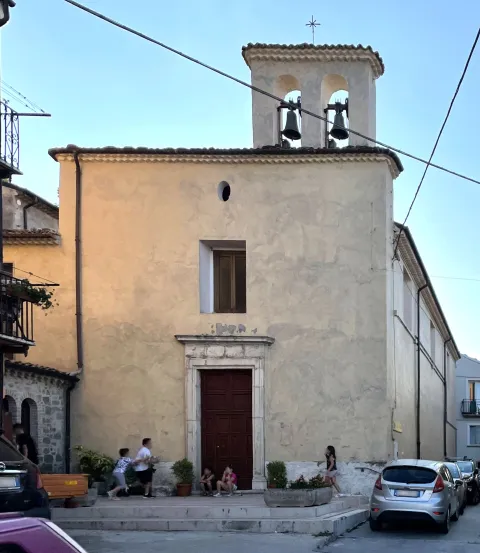
At the centre of the facade stands a portal with a linear architrave, probably late seventeenth-century, under a lunette showing Saint Michael the Archangel crushing Satan; the top is closed by a bell gable pierced by two arches, the bells in plain sight. Inside there is a single nave, about 19 metres long and 6 wide, divided into three bays by round arches and covered with cross vaults; a small choir loft opens above the narthex. A crypt holding many burials runs beneath the floor. A wooden crucifix stands to the right of the entrance; just before the altar, statues of the Sacred Heart and of the Virgin; on the altar, an eighteenth-century statue of Saint Michael.
Our editors' tip
What strikes anyone who knows Bojano is that this church came through the 1805 earthquake unharmed, the one that flattened half the town and forced almost every other church to be rebuilt. Far more recent tremors did the damage instead: closed to worship after the 2013 quake, it reopened only in 2020. The bell tower at the back, above the sacristy, was added in 1976 and is easy to tell apart from the rest with the naked eye. Anyone walking up the road towards Civita Superiore meets it along the way, which is the most natural way to arrive.