The full dedication is to Saint Blaise, bishop and martyr, and in Bojano the choice was anything but casual: Blaise is the patron of wool carders, and carding was a widespread trade in the town. The church first surfaces in the records in 1241, when the stripping of churches ordered by Frederick II cost it a red silk chasuble. Those documents call it «Ecclesia Sancti Blasii de Porta», after the eastern town gate it stood beside — outside the walls at the time, and taken inside them only from the seventeenth century. In 1670 it became an independent parish again, entrusted to don Ascanio Petraccone, after almost a century under the cathedral.
What to see
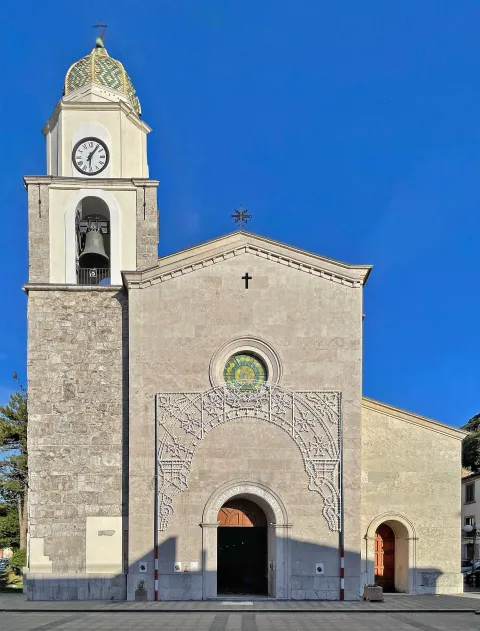
The facade keeps things plain: a stone portal with a linear architrave, older than the earthquake, with a rectangular window and a round one above it; on the north side a bell gable holding two bells. To the right of the door a Roman epigraph from the first half of the third century is set into the wall, one of those reminders of how deep the layers run under Bojano's churches.
Inside, the rectangular hall is split into two unequal aisles: the wider one, to the south, runs from the narthex to the presbytery; the narrower one, to the north, from the sacristy to the large coppered-plaster crucifix given by the Sisters of Good and Perpetual Help. The high altar carries statues of the Immaculate Conception, Saint Pius X and Saint Joseph. What really repays the stop, though, is the chapel of the Sacred Heart, with three frescoes by Romeo Musa: Saint Margaret Mary Alacoque in adoration and two images of Saint Blaise, in one of which he holds the church itself with the neighbouring houses around it. Two more frescoes from the same set were lost when the side arches of the chapel were opened.
Our editors' tip
It helps to know that the floor underfoot is not the original one. The Sant'Anna earthquake of 1805 forced a complete rebuild: the entrance moved to the east and the altar to the west, the reverse of the earlier arrangement, while walls and floor were raised by more than a metre. The chapels along the south side stand where the graveyard used to be. That is why the building reads as old and orderly at the same time: the plan is medieval, the levels are nineteenth-century.