Set into the gate that faces Bovianum is an inscription of about AD 168: an order telling the locals to stop harassing the shepherds who passed through with their flocks. No other document explains this place better. Saepinum was not an isolated town among fields but a station on the great drove road from Pescasseroli to Candela, where the transhumance herds came in through the gates and crossed the decumanus.
The Roman town lies on the plain at the foot of the Matese, three kilometres north of present-day Sepino, in the locality of Altilia. Before moving down, the Samnites held the mountain, with the fortress of Terravecchia watching the Crocella pass; the Romans took the place in 293 BC and life shifted gradually to the road junction linking Beneventum with Corfinium. The circuit of walls standing today is later: Tiberius had it built before he became emperor, as the inscription on the gates records.
What to see
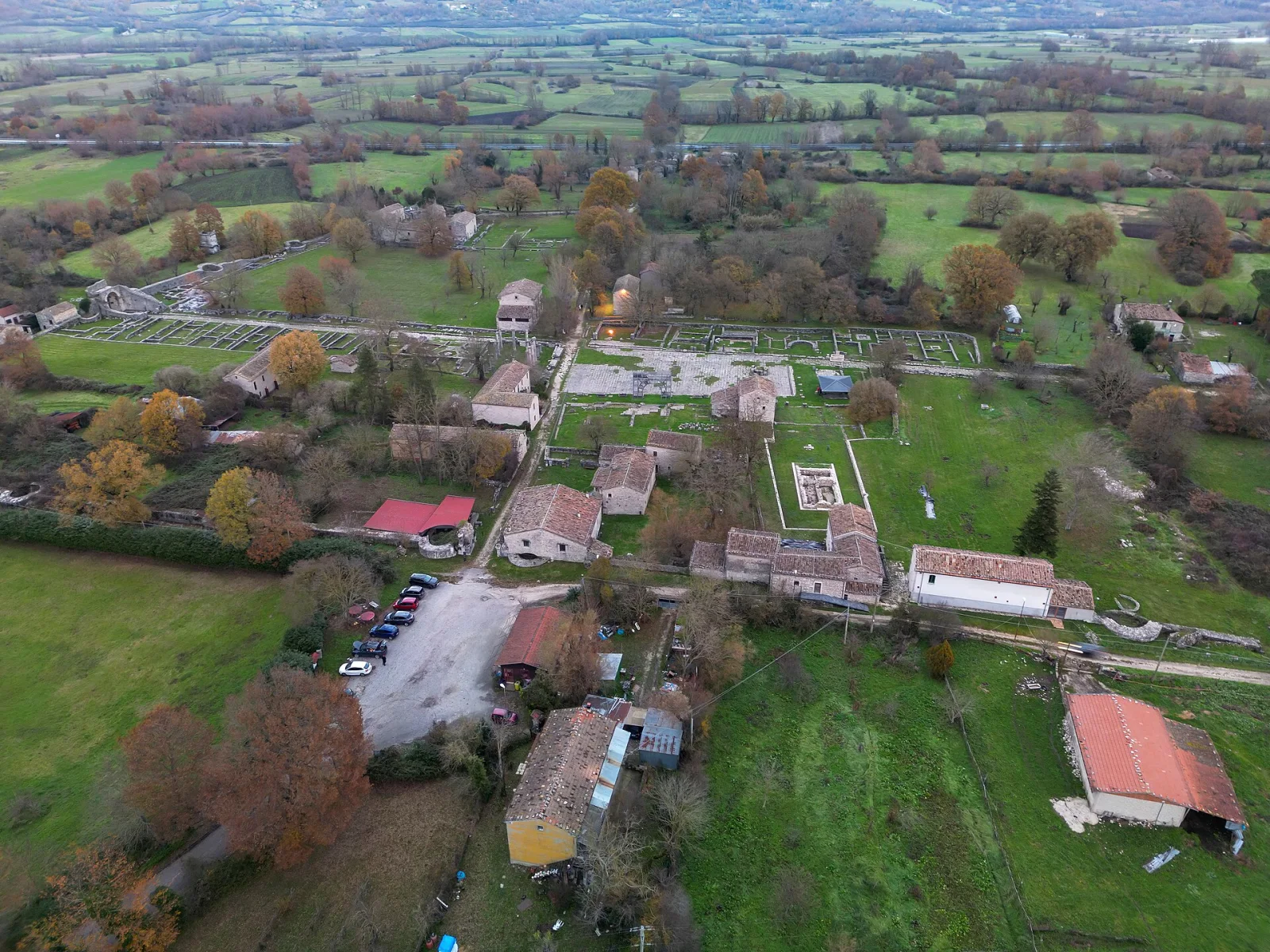
The site covers about a dozen hectares and has kept what has vanished almost everywhere else: the complete perimeter, with four monumental gates at the crossings of cardo and decumanus and nineteen circular towers uncovered in the middle of the twentieth century. The towers project some three metres both towards the countryside and towards the town, with slits on the outer face and small windows on the inner one; the facing in opus reticulatum can still be read block by block, Matese limestone cut into small pyramids. Behind each gate opens the cavaedium, a rectangular courtyard open to the sky that worked as a security lock before the second doorway.
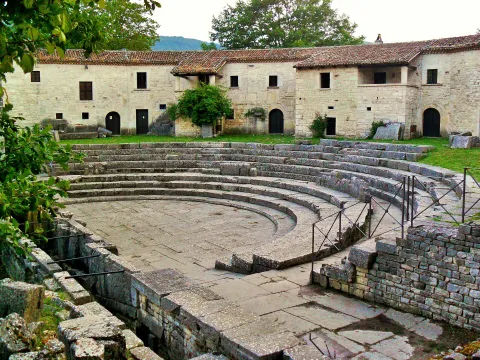
Within the walls stand the forum, the theatre, traces of the temples of Jupiter and Apollo, and the buildings that speak of work: near the forum the excavations identified a tannery and a fullonica, the plant where wool was processed, both already running at the start of the 2nd century BC. Since 2023 archaeologists have been uncovering a house with a monumental entrance on the decumanus maximus, fitted with a hot-water system whose large cylindrical lead vessel was connected to the pipes.
Our editors' tip
In 2021 the Ministry of Culture set up the Parco Archeologico di Sepino: the site is looked after and open, yet it remains one of those places where you end up walking the decumanus almost alone. Come in on foot through the Bovianum gate, following the drove road. The town's abandonment can be read in the 4th-century graves dug inside the walls; in 882 the Saracens came through. The stones stayed where they fell, which is why what was carted away elsewhere is still standing here.