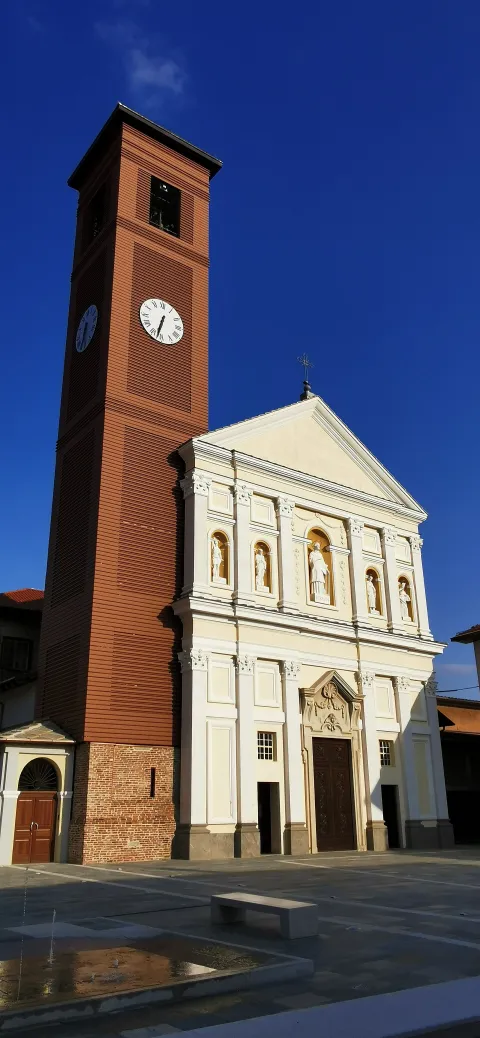
The sanctuary of San Vito Martire stands outside the built-up area of Nole, along the road that leads from the Stura torrent to the centre of the village. At the start there was no church but a votive pillar with the saint's image painted on it, documented from the middle of the sixteenth century: it was a much-travelled stretch of road, and those passing stopped to pray. Between the late sixteenth and the early seventeenth century the community began to build a small chapel around the shrine, and that is the core from which all the rest grew.
What to see
The original pillar is still there, in the middle, but the fresco you see today is of 1648, repainted by the local painter Lorenzo Lega: at the centre the young martyr Vitus, at his sides the apostles Peter and James, above Christ and the Virgin crowning him and offering him the cross and the palm of martyrdom. Beside the altar two older frescoes survive, probably from the building of the chapel, with Saint Anthony Abbot and Saint John the Evangelist. The vault of the first church was decorated in the mid seventeenth century with a feigned architecture that throws it open to the sky; at the centre there must have been Saint Vitus in glory, now lost. In the first half of the eighteenth century came the central nave and the two side chapels. On the front, recently restored, are Saint Vitus in the tympanum and, in the two lower niches, Saint Modestus and Saint Crescentia, already retouched in 1960 by the painter Vincenzo Sebastiano da Levone.
Visiting
Standing outside the village, the sanctuary always needed someone to guard it: since the seventeenth century two rooms beside the church have housed the hermit, the armit in the speech of Nole, placed there by the community. In the nineteenth century the gallery of ex-votos was added, which before hung directly in the presbytery on the frescoed back wall, along with the sacristy behind the original fresco. The interior restorations of the past twenty years have brought back the eighteenth-century decoration of the high altar with its wooden retable, then that of the walls and vaults, down to the seventeenth-century vault of the presbytery, finished in 2012.
Our editors' tip
The story to keep in mind as you go in is that of count Amedeo Cavalleri di Rivarossa. Wounded in battle in the Maritime Alps on 14 June 1794, he put his survival down to the intercession of Saint Vitus; he came here, withdrew as a hermit and stayed until his death in 1837. In those forty years he enlarged the house beside the church, made the garden and the boundary wall that ends in an exedra, and on the exedra he had painted the reason he was there: himself, wounded in battle. Look for it before you go into the church. It is an ex-voto the size of a wall, commissioned by a man who spent more than forty years giving thanks.