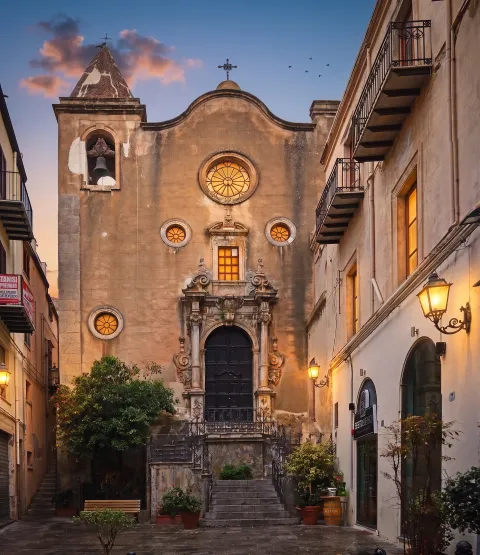
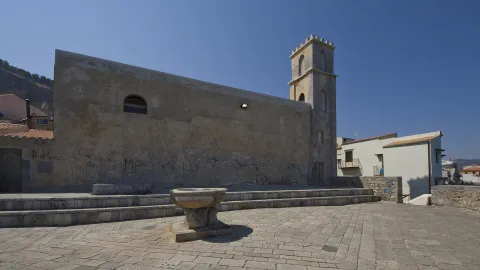
Founded in 1143 by George of Antioch, the Syrian grand admiral serving the Norman King Roger II, the Church of Santa Maria dell'Ammiraglio—commonly known as La Martorana—was inscribed on the UNESCO World Heritage list on July 3, 2015, as part of the Arab-Norman Palermo, Cefalù, and Monreale circuit. Situated in the historic centre of Palermo adjacent to the Church of San Cataldo and facing Piazza Bellini, this medieval Siculo-Norman structure serves as the co-cathedral for the Eparchy of Piana degli Albanesi, officiating Byzantine-rite services for the local Italo-Albanian community.
What to see
Visitors enter the complex through a 12th-century square bell tower, which features ground-floor arcades with corner columns topped by three storeys of double-arched bifora windows. The entrance vestibule displays 18th-century ceiling frescoes painted by Olivio Sozzi, Antonio Grano, and Guglielmo Borremans. Beyond this space, on the wall of the original medieval structure, sit two famous Byzantine mosaic panels. One depicts the founder George of Antioch prostrated at the feet of the Virgin Mary; the other shows King Roger II dressed in full Byzantine imperial regalia receiving his crown directly from Jesus Christ, accompanied by the Greek inscription "Rogerios rex". The core structure retains its Latin-cross layout, pointed arches, and dome squinches. Over the centuries, major alterations took place: architect Paolo Amato replaced the original central apse with a rectangular baroque space between 1683 and 1687, and Nicolò Palma added a baroque facade in 1740. Between 1870 and 1873, architect Giuseppe Patricolo carried out a restoration that stripped away 18th-century marble cladding in an effort to reveal the church's medieval origins.
Visiting
As the parish church of San Nicolò dei Greci, the Martorana serves roughly 15,000 Arbëreshë faithful living across Palermo. Liturgical services and rites follow the Eastern Byzantine calendar, conducted in Ancient Greek and Albanian. Key religious events include Epiphany on January 6th (Teofania / Ujët e pagëzuam), the Feast of Saint Nicholas of Myra on December 6th (Dita e Shën Kollit), and Holy Week (Java e Madhe) culminating in Easter (Pashkët) with the traditional chant "Christos anesti - Krishti u ngjall". Wedding ceremonies held here often feature brides wearing traditional hand-embroidered Arbëreshë costumes from Piana degli Albanesi.
Our editors' tip
Pay close attention to the mosaic panel of Roger II being crowned by Christ. Rather than receiving his authority from the Pope, the Norman ruler chose to be depicted in eastern imperial robes receiving his crown straight from Christ, offering a clear political statement rendered in exquisite Byzantine gold tesserae.