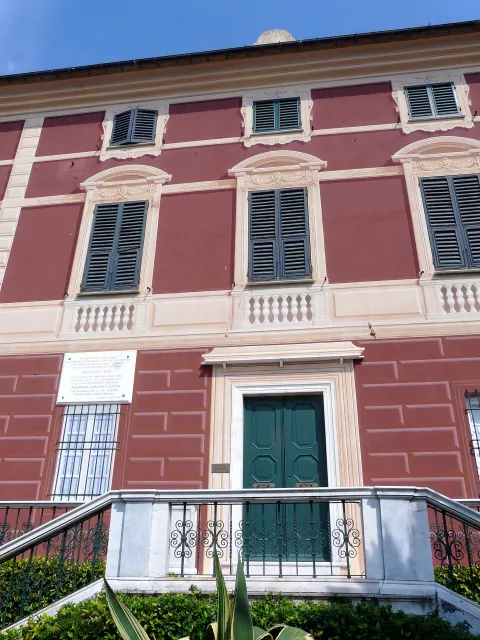
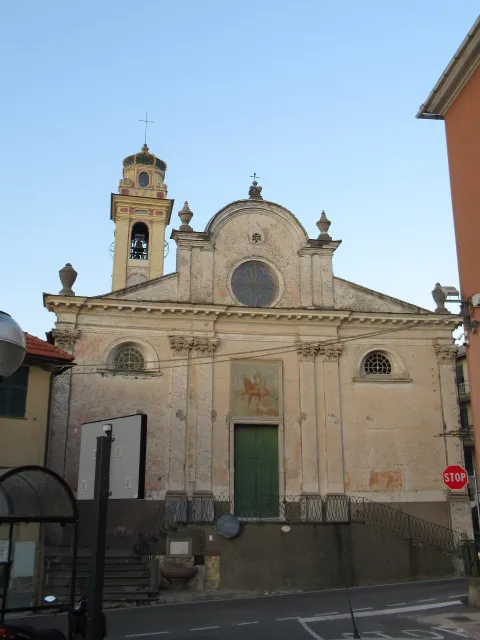
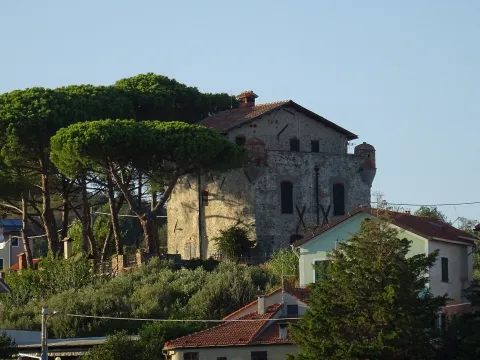
The baptismal font carries the date 1749, a year before the church was consecrated in 1750: the stonecutters had already finished the piece that would be needed first. The church of the Nativity of Mary Most Holy stands in the hamlet of Casanova, in the hills above Varazze, and its façade names the man these slopes claim as their own: in a niche above the door is a statue of Blessed Jacopo da Varagine, born in this area. A little higher up, on a nearby hill, a chapel marks the spot where his birthplace stood.
What to see
Inside there is a single nave with six side chapels. The high altar is marble, and behind it runs a heavy wooden choir; the chapel altars are lime plaster, and above each of them hangs a canvas, dated between the eighteenth and the twentieth century, so that row of walls lines up two hundred years of different commissions. The vault is painted, but it needs patience: candle smoke and time have darkened it to the point where the colours only read where the light falls.
Above the entrance sits an Agati-Tronci pipe organ of 1894, opus number 1155 from the Pistoia workshop. Near the presbytery is a processional case holding a carved group: Jacopo da Varagine making peace between Guelphs and Ghibellines, cut around 1930 by the Savona sculptor Giovanni Battista Rebagliati. Outside, the bell tower carries a low dome covered in ceramic tiles, and the façade stays plain, broken only by the small rose window and the niche. A small oratory stands beside the church; nearby are the chapels of Saint Catherine and of the Blessed himself.
Visiting
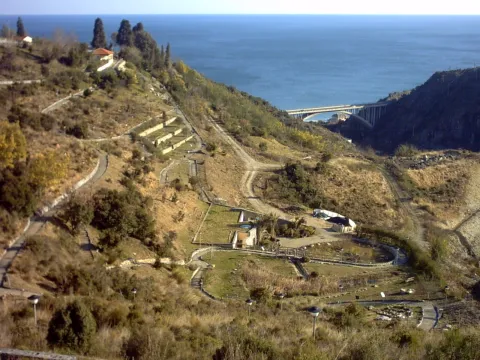
Casanova is a hill hamlet of Varazze, in the province of Savona, reached by the road that climbs the Teiro valley; the church is still the parish seat of the Varazze vicariate, in the diocese of Savona-Noli. It keeps no museum hours: it opens around services, and outside those it is worth asking at the parish. From the square in front of the façade the view drops down the valley to the town of Varazze and the sea, which is one of the better reasons to come up here.
Our editors' tip
We come in late afternoon, when the light enters low and the darkened vault becomes readable again. Then, before leaving, we walk up to the chapel of Blessed Jacopo: it is a short climb, and from up there it is easier to see why the statue ended up on the façade rather than inside.