Chieri keeps a textbook medieval plan — streets radiating and converging on the cathedral — and the cathedral repays the walk: Santa Maria della Scala is among the greatest Gothic churches of Piedmont, with its frescoed baptistery. Of the hundred towers the town once had, exactly one still stands whole, the tower of casa Ferrero, at the corner of via Vittorio Emanuele and piazza Cavour. The wealth came from the looms, and here is the thing nobody expects: in the fifteenth century Chieri wove a blue fustian that left through the port of Genoa, where it served for sailcloth sacks and for covering goods on the quays. By one well-supported account, the name blue jeans comes from exactly there: bleu de Gênes, the blue of Genoa.
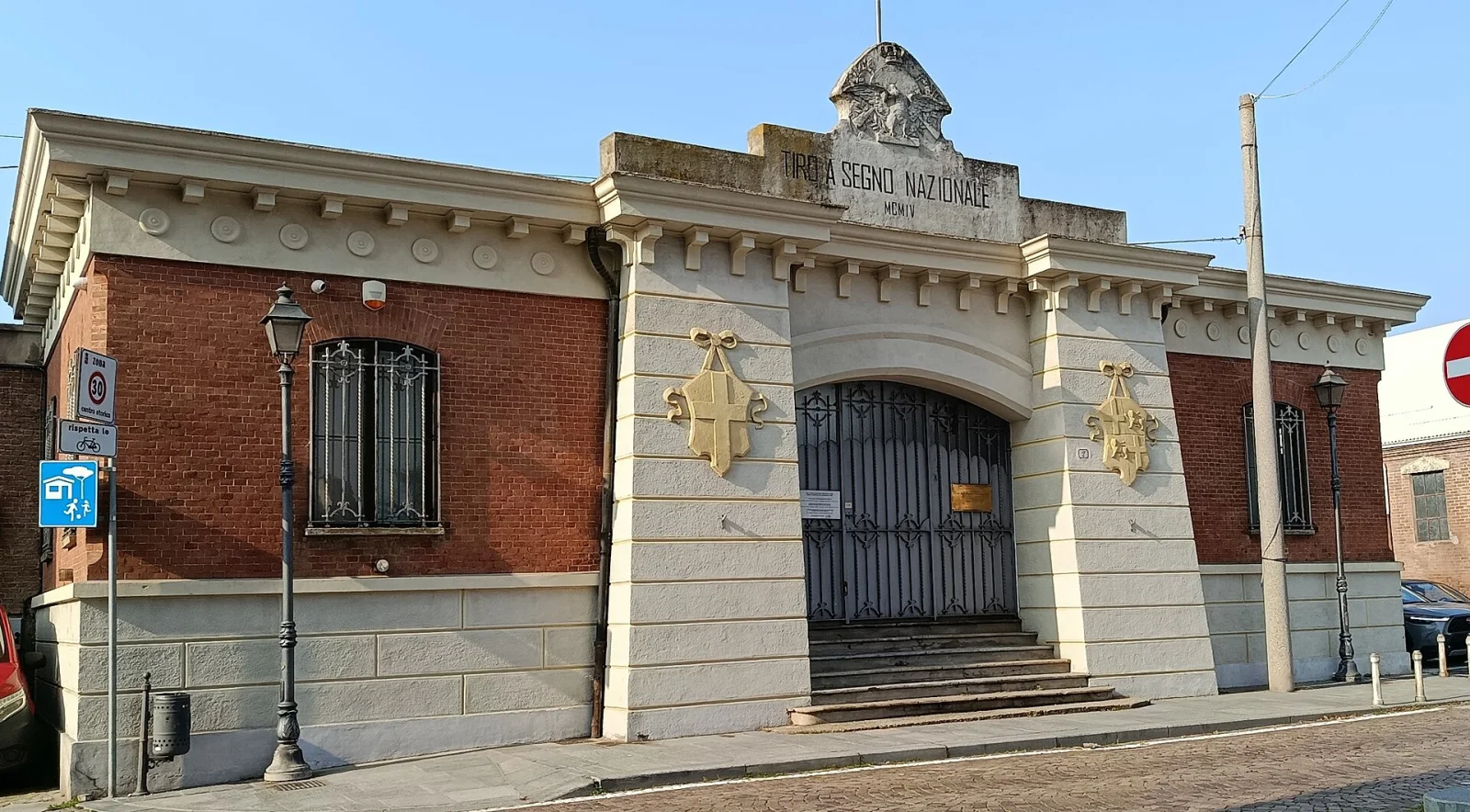
Chieri's coat of arms is a peace treaty. From 1228 the town was split between the Militi, the noble families whose patron was Saint William of Aquitaine and whose gold leopard on red they took, and the society of San Giorgio, which under the cross of Saint George defended the interests of the people, of trade and of the craftsmen. The two factions stopped fighting in 1347, with the act of submission to Amadeus VI of Savoy, and later the two emblems merged into a single one: today's. Between the fifteenth and the twentieth century Chieri had one of the liveliest Jewish communities in Piedmont, and there remain the ghetto, three cemeteries and a few passages that come out at different points of the town; in 1802 one of its members, David Levi, was elected mayor. The church Juvarra held to be one of his masterpieces, Sant'Andrea, was used by the French as a cotton mill and pulled down in 1811 so that it could not become a church again. Today the library sits inside a real cotton mill, the Tabasso. At Pessione the Martini museum tells twenty-five centuries of wine; across the fields runs the forty-fifth parallel, marked by a steel globe on a roundabout. And there are the Freisa di Chieri and the sweet focaccia, the one eaten at the end of the meal.