The castle of La Rotta is an old building of medieval origin in the frazione of the same name in the comune of Moncalieri, at the gates of Turin, about ten kilometres from the centre of Moncalieri. It dates from the twelfth century.
What to see
The place name has an uncertain origin: it may derive from rupta, a disastrous military defeat, or from rotha, an old word for an irrigation ditch, or again from the breaking of the banks of the nearby streams Banna and Stellone; thirteenth-century land records, however, show that the building was called Grancia Rupta, a grange being a sort of fortified farm. It was originally a modest fortified house at a strategic point, defending the nearby bridge over the Banna, on which passed the Roman road coming from Pollentia; the road might suggest a late Roman origin as a probable statio, but there is no concrete evidence. In 1196 the bishop of Turin, Arduino di Valperga, assigned lands and the property to the Knights Templar: the building was the seat of a small convent and of a garrison protecting the bridge, of which remains survive. When the order was dissolved it passed to the Hospitallers, with the right to collect the toll for crossing the bridge. In the fifteenth century it was remodelled and fortified against brigands; from 1452 it was certainly the possession of the count and Grand Prior Giorgio Valperga di Masino, and until the late sixteenth century the family seat of the Valperga di Masino counts. In the seventeenth century it came among the Savoy possessions and was the scene of two battles: in November 1639 Thomas Francis of Savoy, Prince of Carignano, was defeated there by the French army of the Marquis d'Harcourt; in 1706, during the siege of Turin, it was instead the French army that suffered a defeat, while the building served as a gunpowder store for the Savoy troops. In the first half of the eighteenth century it briefly hosted the former king Victor Amadeus II, moved here from Moncalieri castle after being arrested at the wish of his son Charles Emmanuel III; he was then confined at Rivoli and again at Moncalieri, where he died on 31 October 1732.
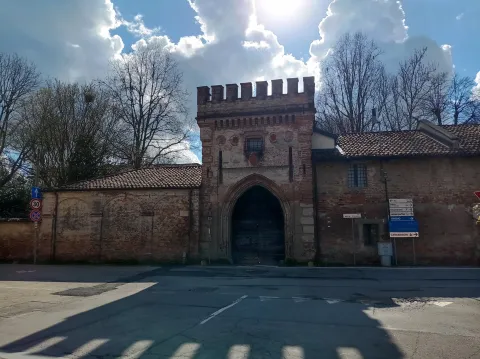
After about a century of abandonment the building was bought by private owners and restored in the eighties of the twentieth century, recovering details of the fifteenth-century structure; during excavations for water pipes the remains of a burial came to light that seemed to be of a Templar knight, with a conspicuous metal cross, traces of armour and the bones of a large animal, perhaps his horse. The plan is quadrangular, with brick fronts and traces of the old moat; two of the three original pointed-arch mullioned windows survive, and traces of crenellation. The main facade is dominated by a square keep with barred windows, topped by a small bell-gable, and three arrow slits reveal the original presence of a drawbridge. The courtyard has a central cistern and the side wings once included the convent area with the cellarium, a reception hall and a chapel with a pointed vault. Isolated in a wooded area, almost beside the A6 Turin-Savona motorway, the castle has a reputation as one of the most haunted manors in Italy, but the source itself notes that it is hard to verify the many testimonies of alleged paranormal phenomena.
Visiting
It is reached by a minor road that branches off the SP393 towards Villastellone and once led to the old Templar bridge over the Banna, of which few ruins remain. The building has passed to private owners: the sources consulted do not say whether or when it can be visited, so check before going.
Our editors' tip
Above the portal a white marble plaque bears the coat of arms of the Valperga di Masino counts, while on a stone jamb a Maltese cross is carved, the sign that ties the building to the Order of the Hospitallers.