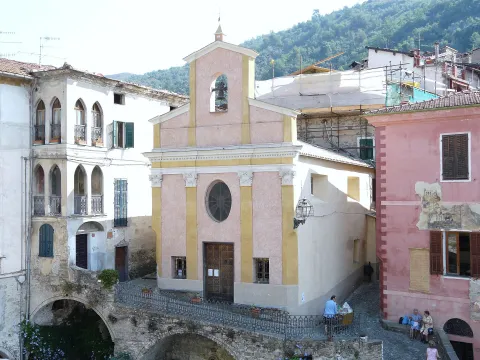
Before town halls existed, village assemblies were held on the churchyard: it was the only flat, public space everyone recognised. A document of 1230 records that here, in front of this church, the members of the parliament of Apricale gathered and appointed the justice of the peace. Today all that is left of that churchyard is ruins.
What to see
Little, to be honest: a few walls, which cannot be visited. But the sources agree that this was the oldest religious foundation in the territory, probably built long before the medieval village came into being, and that it was the first parish church of the small settlements of the valley.
A document of 1166 places it among the dependencies of the priory of Ventimiglia. It is named in the thirteenth-century statutes of Apricale, then in the sixteenth it turns up in a deed to repair a leaking roof, and it is already abandoned. The last certain news is of the eighteenth century, when a prior was appointed to look after it. After that, silence.
Visiting
The remains are about three kilometres from the centre of Apricale, along the road to Pigna; there is nothing to go into and there are no hours, you see the site from outside as you pass. Ten minutes.
Our editors' tip
Cover those three kilometres and then look back towards Apricale, perched on its spur. The oldest church in the valley is not in the village: it is out in the fields, where people used to live before. In the middle ages villages moved uphill to defend themselves, and left their churches down below, keeping the dead company.